

Tomorrow, Hillary Clinton will unveil her proposal to rein in out-of-control prescription drugs costs—an issue that countless voters have raised as a priority for Clinton on the campaign trail. But, in contrast with Clinton’s bold tackling of the issue, Republicans—like Jeb Bush, Marco Rubio, Scott Walker and Chris Christie—have enacted policies that increased the out of pocket cost to consumers and made it more difficult for Americans to purchase their prescription medications.
The GOP’s silence on prescription drug costs will not go unnoticed, certainly not while Hillary Clinton takes on an issue so critically important to the American people.
Jeb Bush
Jeb Bush proposed reducing state’s payments for prescription drugs for Medicaid patients. “The spending reductions he recommended included about $ 225 million less in the state’s contribution to the pension fund, reduced payments for drugs for Medicaid patients and scattered economies throughout the government such as elimination of vacant positions. The most controversial proposed cut may be the $ 107 million reduction in payments for pharmaceuticals for Medicaid patients.” [Times-Union, 2/3/99]
Jeb Bush signed a $22.5 million cut to prescription drug assistance for poor seniors. “Some services for lower-income Floridians face reductions. Drug assistance for poor seniors, for example, faces a $22.5 million cut, halting plans to expand a program now used by 8,100 elderly.” [Orlando Sentinel, 12/3/01]
Jeb Bush vetoed $90,000 for a prescription access for the underserved program at the Suncoast Community Health Center. According to Jeb Bush’s 2002 veto message, “Specific Appropriation 574 Pages 112 and 113 – A portion of proviso language […] Prescription Access For The Underserved – Suncoast CHC – Hillsborough 90,000’” [Jeb Bush 2002 Veto Message, 6/5/02]
Jeb Bush signed a requirement that Medicaid and Medically Needy recipients pay a 2.5 percent co-pay for each prescription drug up to $7.50 per month. “Medicaid and Medically Needy recipients will pay a 2.5 percent co-pay for each prescription drug up to $7.50 per prescription per month.” [St. Petersburg Times, 5/23/03]
Jeb Bush recommended an $8 million cut to Medicaid prescription drug reimbursements for pharmacists. “Also taking a hit would be pharmacists, who would see the state pay them less to fill a Medicaid prescription, saving about $8-million. HMOs would see a 1 percent cut in their reimbursement for taking on Medicaid clients, saving $5-million.” [St. Petersburg Times, 1/21/04]
Jeb Bush pushed to limit the number of medications readily available to poor people. “Even Republicans are wary of the governor’s plan to cut costs by limiting prescription drugs. Gov. Jeb Bush’s plan to cut Medicaid costs by limiting the number of medications readily available to poor people is being met with stiff resistance from lawmakers in the governor’s own party. Senate President Toni Jennings and Speaker of the House John Thrasher both said Friday that they have real concerns about Bush’s plan. A House budget committee did not even consider the proposal when it met earlier this week. A Senate budget committee considered a much scaled-back version of the proposal Friday, but it too was criticized.” [St. Petersburg Times, 3/6/99]
- Republican Speaker of the Florida House John Thrasher: Jeb Bush’s medication plan got close to politicians “trying to practice medicine.” According to the St. Petersburg Times, “Thrasher, who for nearly 20 years served as the general counsel for the Florida Medical Association, didn’t rule out a compromise on Bush’s plan but said he wants to look at other ways to cut Medicaid costs. ‘There’s a lot of judgment that goes into formularies in terms of which drugs to put on there,’ Thrasher said. ‘You get into those types of decisions and that gets close to us trying to practice medicine.’” [St. Petersburg Times, 3/6/99]
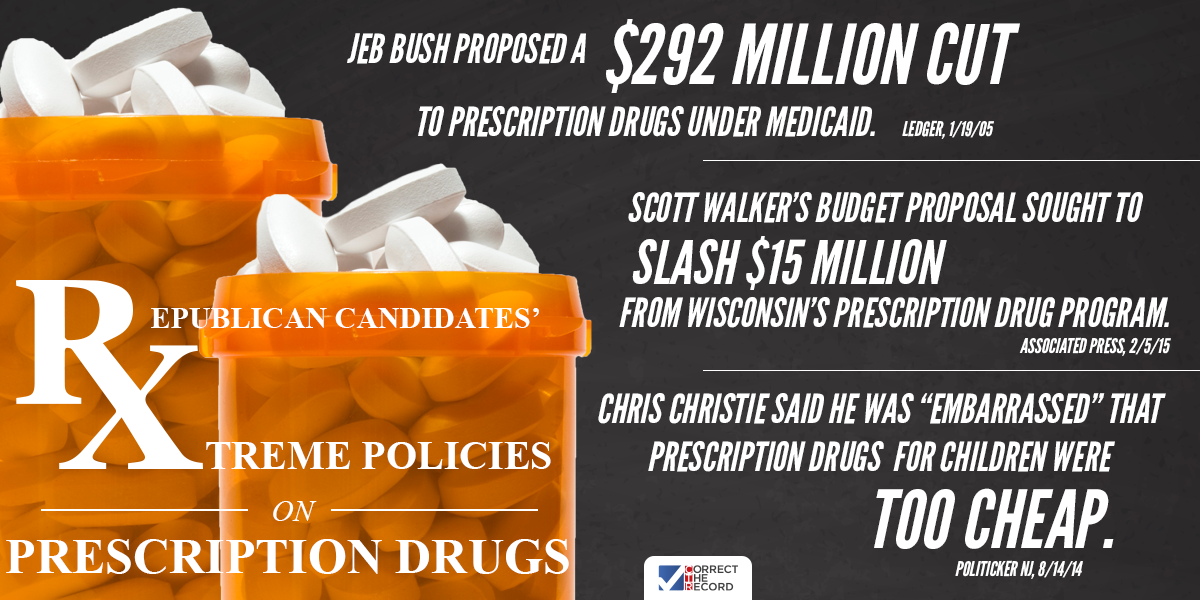
Jeb Bush proposed a $292 million cut to prescription drugs under Medicaid. “Bush also proposed some major cuts in the $ 14.7 billion Medicaid program, including a $ 300 million cut in the Medically Needy initiative that helps 36,000 catastrophically ill Floridians who have exhausted their private insurance. The recipients would lose their hospitalization but could still get prescription drugs. Bush also supports more restrictions on the use of prescription drugs by Medicaid patients, which represents another $ 292 million cut.” [Ledger, 1/19/05]
Scott Walker
Scott Walker considered cuts to Milwaukee County’s medical safety net program that would result in increased prescription drug costs for the poor. “Seven years after Milwaukee County committed to serving the uninsured after closing Doyne Hospital, County Executive Scott Walker is contemplating major cuts in – or elimination of – the county’s health care program for the poor, which served 29,000 residents last year. Walker said the county’s ongoing budget squeeze and the fact that no state law mandates the safety-net General Assistance Medical Program explains his consideration of reducing the county’s $13.7 million tax-levy support by $1 million to $5 million, or phasing it out entirely. […] It would also mean a new co-pay of $10 per visit to specialty physicians, boost the GAMP semiannual application fee from $35 to $50, and ask patients to pay more for prescription drugs, according to Henken. It would mean a loss of $1.4 million in matching funds.” [Milwaukee Journal Sentinel, 8/25/05]
Scott Walker’s budget proposal sought to slash $15 million from Wisconsin’s prescription drug program. “Gov. Scott Walker’s executive budget would cut $15 million from the state’s popular SeniorCare program over the next two years. The program provides senior citizens with prescription drug benefits. The governor’s budget would slash $15 million in state tax dollars from the program, resulting in the loss of a matching $15 million in federal funding and $66 million in program revenue. The only explanation Walker has offered is the cuts will ensure coherent alignment with Medicare Part D. The governor’s spokeswoman had no immediate explanation.” [Associated Press, 2/5/15]
Scott Walker’s budget would push Wisconsin seniors off of the state’s popular prescription drug program into the potentially more expensive Medicare Part D benefit. “Pushing eligible recipients of the state’s popular SeniorCare prescription drug plan into the potentially more expensive federal Medicare Part D benefit. It isn’t clear yet how many of the roughly 87,000 SeniorCare members would be affected. A similar proposal made in Walker’s 2011 budget bill was scrapped because of opposition from both Democratic and Republican lawmakers. […] Seniors ages 65 and older pay a yearly $30 enrollment fee for SeniorCare as well as co-payments ranging from $5 to $15, but unlike the federal plan the Wisconsin plan is simpler and has no gaps in coverage.” [Journal-Sentinel, 2/23/15]
Marco Rubio
Marco Rubio supported the 2011 Ryan budget plan despite it increasing “out-of-pocket costs for the typical Medicare patient…by more than $6,000 a year.” “The Ryan budget plan […] would increase out of pocket costs for the typical Medicare patient of the future by more than $6,000 a year. Rubio said he still supports the Ryan plan. He said the message from constituents was that they wanted to ‘save Medicare.’ ‘The political risks are dwarfed by the real risks of allowing Medicare to go bankrupt,’ […] ‘The political risks do not measure up to the real risks of allowing Medicare over the next 5 to 12 years to have to cut benefits because it runs out of money.” [Sun-Sentinel, 5/10/11]
- The Ryan plan would reopen the “doughnut hole” in the Medicare prescription drug benefit. “But the proposal would also repeal last year’s health care law, which means reopening a coverage gap in Medicare’s prescription-drug benefit that the statute closed. The gap, commonly called the ‘doughnut hole,’ requires seniors to pay 100 percent of any prescription costs after the annual total reaches $2,840 and until it hits $4,550. Those who spend more or less have at least three-quarters of the costs covered. Under the 2010 health law, Medicare will pay 7 percent of the cost of generic drugs and 50 percent on name-brand pharmaceuticals; by 2020, the doughnut hole will be closed.” [National Journal, 6/6/11]
Chris Christie
Chris Christie said he was “embarrassed” that prescription drugs for children were too cheap. “In a tirade against Barack Obama’s policies as U.S. President at one of his summer town halls here today, New Jersey Gov. Chris Christie said he’s ‘embarrassed’ that he has to pay $3 dollars for his kids’ prescriptions when he goes to his local pharmacy. ‘I get this health plan now,’ Christie said, referring to ObamaCare, the president’s signature health care legislation. ‘And I have to tell you the truth, it’s embarrassing. I go to the pharmacy to pick up a prescription for one of my kids and you know what I pay most of the time? Three dollars. Three dollars for anything. And the guy behind the counter is looking at me, knowing he’s paying for me to get that. I’m embarrassed by that. It’s too rich. We can’t afford it.’” [Politicker NJ, 8/14/14]
Chris Christie’s proposed 2011 budget would increase fees for prescription drugs for the aged and disabled. “Beginning in January, Pharmaceutical Assistance to the Aged and Disabled beneficiaries would be required to cover an annual deductible of $310. Also, the co-payment for brand-name drugs rises from $7 now to $15 and the co-payment for generic drugs would drop from $6 now to $5. Senior Gold enrollees will also have to pay the $310 deductible and additional coinsurance.” [Home News Tribune, 3/16/10]
Newark Star-Ledger Editorial: Chris Christie “slashed important senior programs, like prescription drug assistance.” “Lately, the governor reminds us of a firefighter who torches a house so he can rush in, put out the blaze and be the hero. After two years of sticking it to fixed-income seniors (while protecting millionaires), Chris Christie is now sucking up to them in town hall meetings, even popping up at their kitchen tables to tell them he feels their pain. Of course he does. He inflicted a lot of it. He cut property tax relief, making it tougher for them to stay in the very homes he’s visiting. And he slashed important senior programs, like prescription drug assistance.” [Newark Star-Ledger editorial, 8/9/11]