

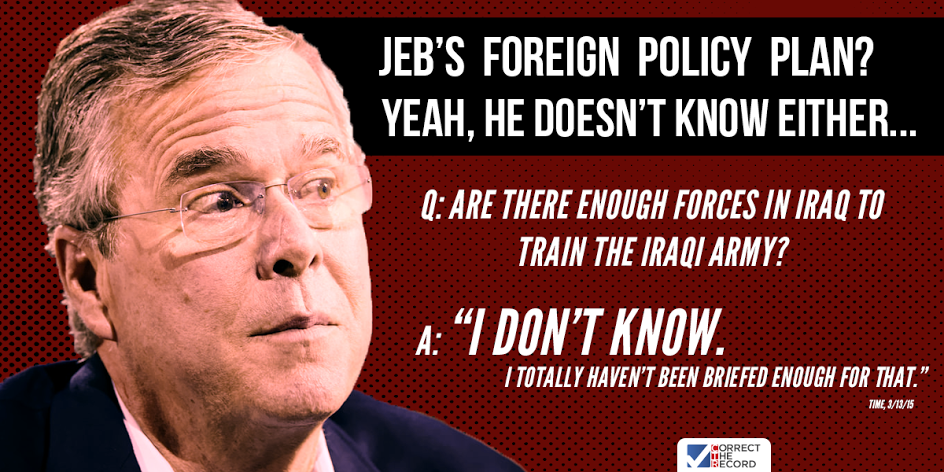
Today Jeb Bush will deliver a speech at The Citadel in South Carolina, where he will lay out his strategy to tackle ISIS. According to Politico, Jeb’s “plan” consists of four points that we say sound like slogans and reveal zero specifics.
It’s likely that Jeb’s proposal will remind reporters of George W. Bush’s foreign policy, considering Jeb has already consulted many of the same advisors as his brother. Americans have already seen how this plan plays out and we can’t afford to make the same mistakes of the past. This election, as Jeb will say, “We are choosing the leader of the free world.” Unfortunately for Jeb, he is not that leader.
Jeb’s Uninformed Foreign Policy
Incoherent Foreign Policy
Inexperienced on Foreign Policy
Slate’s Fred Kaplan: Jeb Bush’s first “major foreign policy address…was a hodgepodge of revisionist history, shallow analysis, and vague prescriptions.” “Most presidential candidates who deliver a ‘major foreign policy address’ have something original, potent, or insightful to say. On Tuesday night, as with most other aspects of his campaign to date, Jeb Bush defied expectations. His 40-minute speech, at the Ronald Reagan Presidential Library, was a hodgepodge of revisionist history, shallow analysis, and vague prescriptions.” [Slate, 8/12/15]
Slate’s Fred Kaplan: Jeb Bush’s pledge to undo the Iran deal as president would “shatter that trust and diminish that leadership” with American allies abroad. “Throughout the speech, Bush spoke of restoring trust in American leadership. But what he proposed doing in his first days as president—scuttling a deal that the nation’s top diplomats and scientists negotiated alongside five great powers of Europe and Asia, and that the U.N. Security Council then unanimously endorsed—would shatter that trust and diminish that leadership.” [Slate, 8/12/15]
Newsweek: Jeb Bush’s “military experience is confined to heading the Sunshine State’s National Guard.” “Jeb Bush has experience in international trade both as Florida’s commerce secretary and as the state’s two-term governor, but his military experience is confined to heading the Sunshine State’s National Guard.” [Newsweek, 11/16/15]
Jeb Bush said he didn’t know what the term “caliphate” meant a year ago. “Republican presidential candidate and former Florida Gov. Jeb Bush, speaking about the Islamic State at a campaign event last week at a Coca Cola bottling plant in Atlantic, Iowa, said he didn’t know what the term ‘caliphate’ meant a year ago. ‘Could you ever imagine a caliphate — I didn’t even know what the term meant, literally, a year ago — a caliphate the size of Indiana, garnering energy each and every day because of our inaction?’ Bush said. ‘Recruiting Americans to go fight their fight in the caliphate, that is in Syria and Iraq, but also recruiting Americans to do harm to us here. Thousands and thousands of Internet exchanges trying to recruit people who have a delusional view of this great country of ours.’” [Buzzfeed, 11/16/15]
Jeb Bush claimed the Obama administration’s approach to foreign policy used too many “big-syllable words and lots of fancy conferences and meetings.” “You don’t have to be the world’s policeman, but we have to be the world’s leader—and there’s a huge difference. This guy, this president and Secretary Clinton and Secretary Kerry. When someone disagrees with their nuanced approach—where it’s all kind of so sophisticated it makes no sense, you know what I’m saying? Big-syllable words and lots of fancy conferences and meetings—but we’re not leading, that creates chaos, it creates a more dangerous world.” [C-SPAN, 7/10/15]
Signaled Willingness to Commit the U.S. to Open-Ended Involvement in Syria
The American Conservative HEADLINE: “Jeb Bush Shouldn’t Talk About Quagmires (or Foreign Policy)” [American Conservative, 11/17/15]
American Conservative’s Daniel Larison: Jeb Bush “accuses Obama of getting the U.S. into quagmire in Syria in the same breath that he pledges to commit the U.S. to an open-ended mission ‘to bring stability’ in Syria.” “Bush accuses Obama of getting the U.S. into quagmire in Syria in the same breath that he pledges to commit the U.S. to an open-ended mission ‘to bring stability’ in Syria. Bush’s plan involves not only creating safe zones that will have to be defended by ground forces (most of which will inevitably be American), but also includes defeating ISIS and Assad and then remaining behind for some unknown period of time until the country has been stabilized.” [American Conservative, 11/17/15]
- Larison: Jeb Bush “claims that he will have a strategy for achieving his extremely ambitious and costly goals, but so far all he is doing is telling us that he will commit the U.S. to war and occupation in Syria with no end in sight.” “Bush claims that he will have a strategy for achieving his extremely ambitious and costly goals, but so far all he is doing is telling us that he will commit the U.S. to war and occupation in Syria with no end in sight. If Obama risks getting the U.S. into a quagmire, Bush wants to guarantee that it will be stuck in one at great cost for many years.” [American Conservative, 11/17/15]
Tufts University’s Daniel Drezner: Jeb Bush suggested that the Iraq troop surge could “simply be replicated again in Iraq and Syria.” “The surge was always designed to be a short-term, temporary effort to establish order in Iraq long enough for the local political actors to broker a deal that would prevent a return to violence. The problem was that once the George W. Bush administration also chose to back an Iraqi leader hell-bent on sectarianism, the short-term benefits of the surge were always going to dissipate. The rest of Jeb Bush’s speech, pivoted off of the mistaken idea that the surge could simply be replicated again in Iraq and Syria.” [Washington Post, 8/13/15]
- Tufts University’s Daniel Drezner: “No diplomatic or military surge is going to fix” the problems in Iraq and Syria. “Imagine the political problems that existed in Iraq in 2007, and multiply them a hundred-fold, and you have Syria right now. No diplomatic or military surge is going to fix that problem for anything more than a nanosecond.” [Washington Post, 8/13/15]
All Over the Map on ISIS
Jeb Bush said the United States needed “some small force level” to train Iraqi soldiers…
Jeb Bush said that the U.S. needed to “reengage with some small force level” to train Iraqi soldiers. “In his remarks to the roughly 30 business leaders, Bush criticized Obama for failing to maintain a U.S. military presence in Iraq after 2010, repeating his assertion that the U.S. withdrawal allowed for the rise of the Islamic State of Iraq and Greater Syria (ISIS). ‘Now we need to reengage with some small force level to continue to train the Iraqi army,’ and to ensure that Sunni and Shia militias are united against the militant group.” [TIME, 3/13/15]
- Jeb Bush, when asked if he would send additional forces to Iraq beyond the thousands already deployed by the Obama administration: “I don’t know.” “Asked by reporters whether Obama’s deployment of thousands of U.S. troops to do just that was sufficient or whether he would call for even more American forces to be sent to Iraq, Bush said, ‘I don’t know.’ ‘I totally haven’t been briefed enough for that,’ he added.” [TIME, 3/13/15]
… then claimed that “boots on the ground” might not be necessary …
Jeb Bush suggested that “boots on the ground” might not be necessary to combat ISIS. “Earlier in the same forum, Bush suggested that deploying ‘special forces’ to fight the Islamic State terrorist group would be a good idea but that ‘boots on the ground’ might not be necessary. ‘Not sure I understand Jeb’s distinction between boots on the ground and special forces on the ground,’ tweeted Jonah Goldberg, an editor-at-large at the conservative National Review Online. ‘Do they not wear boots?’” [Washington Post, 8/5/15]
… then said that the United States should “declare war” and apply “massive force” to achieve “total victory.”
Jeb Bush said he supported the United States’ military using “massive force” to achieve “total victory” over ISIS. SCHMIDT: “Military action, governor, defined in the post-Vietnam era by General Powell was that when the United States acts under the Powell doctrine, we do so with overwhelming force. […] Define victory for the type of military action you’re talking about with regard to the Islamic State.” BUSH: “The Powell doctrine applies here. It definitely applies here, where you do this in unison with the rest of the world. You do it with massive force. You do it with the stated objective of total victory.” [MSNBC, 11/16/15]
Jeb Bush said that the U.S. should “declare war” on ISIS, using “all of the power that the United States can bring to bear, both diplomatic and military.” “On Sunday’s edition of ‘Meet the Press,’ Jeb Bush said that it was time for the United States to go to war with ISIS, and to put together an international coalition to rout the jihadis from their strongholds in Syria and Iraq. ‘We should declare war and harness all of the power that the United States can bring to bear, both diplomatic and military of course, to be able to take out ISIS,’ Bush, who is trailing badly in the G.O.P. Presidential polls, said. ‘We have the capabilities of doing this, we just haven’t shown the will.’” [New Yorker, 11/16/15]
Would Repeat George W. Bush’s Mistakes
Salon’s Simon Maloy: Jeb Bush’s “foreign policy, while painfully vague, tracks nicely with the contours of the Bush Doctrine.” “Jeb’s foreign policy, while painfully vague, tracks nicely with the contours of the Bush Doctrine: projecting American military force to promote ‘freedom’ and advance American interests. It’s helpful to be reminded at times that really nothing has changed within Republican foreign policy circles since the end of the Bush administration: the ideas are the same, even the faces are the same, and the outcomes won’t likely be any different.” [Salon, 10/21/15]
Washington Post’s Paul Waldman: Jeb Bush’s foreign policy looked “a lot like the return of the Bush Doctrine, just with a different Bush.” “Jeb Bush will be making a speech on foreign policy today, and if the excerpts that his campaign released to reporters beforehand are any indication, it will embody all the thoughtfulness, nuance and sophistication that have characterized Republican foreign policy thinking in recent years. If you were thinking that Bush might be the grown-up in this field — or offer something much different from the approach that was so disastrous for his brother — well, think again. It’s looking a lot like the return of the Bush Doctrine, just with a different Bush.” [Paul Waldman, Washington Post, 8/11/15]
CATO Institute’s Doug Bandow: Jeb Bush was “oblivious to the consequences of U.S. policy” and would be “a rerun of Dubya’s disastrous presidency.” “Bush contended that America’s ‘alliances need rebuilding.’ Which means increasing subsidies for rich industrialized states, which are capable of defending themselves. Bush also believes in placating authoritarian governments—Egypt, Saudi Arabia, and others. So much for democracy and liberty. Finally, like other Republican presidential wannabes, Bush is oblivious to the consequences of U.S. policy. Droning, bombing, invading, and occupying other nations create blowback. While Washington’s behavior doesn’t justify terrorism, promiscuous intervention helps explain it. Americans can’t afford a rerun of Dubya’s disastrous presidency.” [CATO Institute, 8/18/15]
Embraced False Narratives about his Brother’s Foreign Policy
Claimed Victory in Iraq Was “Thrown Away” by the Obama Administration
Jeb Bush failed to acknowledge that his brother signed the status of forces agreement that led to the Iraq troop withdrawal. “‘Why,’ he asked, ‘was the success of the surge followed by a withdrawal from Iraq?’ The ‘fatal error,’ he answered, was the ‘premature withdrawal’ ordered by President Obama and Secretary of State Hillary Clinton, who ‘stood by’ as our ‘hard-won victory’ was ‘thrown away’ in ‘a blind haste to get out’—leaving a vacuum that Iran and ISIS filled. Bush got a crucial fact wrong in this chronicle: His brother’s administration—not Obama’s—signed the status of forces agreement, on Nov. 17, 2008, which stated, in Article 24: ‘All the United States Forces shall withdraw from all Iraqi territory no later than December 31, 2011.’” [Slate, 8/12/15]
Claimed ISIS “Didn’t Exist” During his Brother’s Presidency
CATO Institute’s Doug Bandow: Jeb Bush “misleadingly argued that ISIS ‘didn’t exist when my brother was president’” although “ISIS is an outgrowth of al-Qaeda in Iraq, which developed in response to George W. [Bush’s] invasion.” “Bush misleadingly argued that ISIS ‘didn’t exist when my brother was president’ and that a continued U.S. military presence ‘would not have allowed’ the group to flourish. This is false. ISIS is an outgrowth of al-Qaeda in Iraq, which developed in response to George W.’s invasion. The group grew in opposition to the U.S. occupation and Shia-majority regime installed by Washington.” [CATO Institute, 8/18/15]
PolitiFact rated Jeb Bush’s claim that ISIS “didn’t exist” during his brother’s presidency as “Mostly False.” “Bush said, ‘ISIS didn’t exist when my brother was President. Al-Qaida in Iraq was wiped out when my brother was president.’ There are problems with both pieces of Bush’s claim. Yes, a group called ISIS didn’t exist while Bush was president, but the roots of the organization were indeed present and operating under a different banner. As far as claiming al-Qaida was ‘wiped out,’ most experts consider that a stretch. The group’s power certainly diminished under Bush but it wasn’t wiped out. Bush’s statement contains an element of truth but ignores critical facts that would give a different impression. We rate this claim Mostly False.” [PolitiFact, 5/28/15]
Iraq War
Said He Would Have Launched the Iraq War
Washington Examiner: Jeb Bush gave an “unhesitating yes” when asked if he would have invaded Iraq “knowing what we know now.” “Is it possible that in 2016, more than a decade after the invasion of Iraq, the Republican party’s presidential nominee could become bogged down in debating whether the war was the right thing to do? The answer, a depressing one for many in the GOP, is yes — if the nominee is Jeb Bush. Fox News’ Megyn Kelly asked Bush a straightforward, concise question: ‘Knowing what we know now, would you have authorized the invasion?’ Bush’s answer was an unhesitating yes. ‘I would have, and so would have Hillary Clinton, just to remind everybody,’ Bush said, ‘and so would have almost everybody that was confronted with the intelligence they got.’” [Washington Examiner, 5/11/15]
Washington Post: When asked again if he would invade Iraq “based on what is known now,” Jeb Bush replied “‘Yes’ or ‘I don’t know,’ or has refused to answer, depending on the venue.” “Jeb Bush came face-to-face here Wednesday with the perils of carrying a politically divisive family name, skirmishing with voters over the Iraq war and continuing to struggle with how to differentiate himself from his brother. Asked repeatedly in recent days whether he would have supported an Iraq invasion based on what is known now, the former Florida governor has replied ‘Yes’ or ‘I don’t know,’ or has refused to answer, depending on the venue. The stumbles mark the toughest period yet for Bush’s still-undeclared campaign and have lit a fire under his likely GOP opponents, many of whom have happily proclaimed that they would not have authorized the Iraq invasion under those conditions. Many conservative leaders and pundits are also lacerating Bush as appearing unprepared to address an obvious topic and are casting him as a tone-deaf relic of the GOP elite.” [Washington Post, 5/13/15]
- Rolling Stone’s Matt Taibbi: Jeb Bush’s answer on Iraq was “characteristically Bushian: yes, no, and maybe.” “Jeb’s answer was characteristically Bushian: yes, no, and maybe. Bush III somehow hadn’t prepared for the one question he was most absolutely certain to face the moment he decided take a step in the direction of the White House.” [Rolling Stone, 5/18/15]
Jeb Bush eventually changed his answer on whether he would have invaded Iraq, saying he “would have not engaged.” “After days of sidestepping, Jeb Bush on Thursday offered a definitive answer to the question of whether he would have authorized the invasion of Iraq in 2003 had he known about the intelligence failures at the time. Knowing what we know now, Mr. Bush said: ‘I would have not engaged. I would not have gone into Iraq.’ His reply seeks to resolve a controversy — involving judgment and family loyalty — that had hung over him for much of the week, after an interview with Fox News, in which Mr. Bush seemed to suggest he would have authorized the war in Iraq even if he knew of the intelligence failures that preceded it. Later, he said he had misunderstood the question, and, later still, said he refused to answer such hypothetical questions because they were insensitive to the families of troops who had died in Iraq.” [New York Times, 5/14/15]
- Politico: Jeb Bush’s flip-flop on the authorization of the Iraq war was a “humiliating reversal.” “It was a humiliating reversal for a proud and loyal member of the Republican Party’s foremost political dynasty — and a puzzling climax to a week that found the GOP’s would-be frontrunner bobbling the biggest question hanging over his candidacy: Is he his ‘own man,’ as he has insisted time and again, or not?” [Politico, 5/14/15]
Praised George W. Bush’s Handling of Iraq
Jeb Bush: “I think people will respect the resolve that my brother showed, both in defending the country and the war in Iraq.” BUSH: “Yes. You know, a lot of things in history change over time. I think people will respect the resolve that my brother showed, both in defending the country and the war in Iraq. But history will judge that in a more objective way than today.” [CNN’s State Of The Union, 3/10/13]
Jeb Bush: “Taking out Saddam Hussein turned out to be a pretty good deal.” “He also pointed to the decisions he regards as a success. ‘Taking out Saddam Hussein turned out to be a pretty good deal,’ Bush said in a reference to the execution of the Iraqi president.” [Bloomberg, 8/13/15]
Jeb Bush, when asked how it felt to have “a brother who should be responsible” for 406,000 deaths in Iraq: “I’m proud of my brother, and he did what he had to do.” “Bush is the son of former President George H.W. Bush and younger brother of former President George W. Bush. The latter was the focus of one of the questions from the audience of about 100 people during the town hall event. ‘With all due respect, how does it feel having a brother who should be responsible for over 6,000 soldiers (dying) in the unjustified war with Iraq, you know, the 400,000 innocent civilian deaths also?’ asked Dubuque resident Jeff Lenhart, who identified himself as a Democrat and was among the first attendees to arrive. ‘How does it feel?’ Jeb Bush asked. ‘Look, I’m proud of my brother, and he did what he had to do.’” [Dubuque Telegraph-Herald, 5/16/15]
Jeb Bush praised his brother’s “heroic and courageous” troop surge in Iraq. “Bush is the son of former President George H.W. Bush and younger brother of former President George W. Bush. The latter was the focus of one of the questions from the audience of about 100 people during the town hall event. ‘With all due respect, how does it feel having a brother who should be responsible for over 6,000 soldiers (dying) in the unjustified war with Iraq, you know, the 400,000 innocent civilian deaths also?’ asked Dubuque resident Jeff Lenhart, who identified himself as a Democrat and was among the first attendees to arrive…Bush acknowledged ‘mistakes’ were made in Iraq, but He said he thought his brother was ‘heroic and courageous’ in ordering a surge of troops in Iraq.” [Dubuque Telegraph-Herald, 5/16/15]
Washington Post’s Paul Waldman: Jeb Bush used the Iraq drawdown “to justify a renewal of the Bush Doctrine.” “But Republicans tell a different story, one that not only wipes away all the calamitous and naive decisions of the Bush administration but also can be used to justify a renewal of the Bush Doctrine anywhere. Here’s how Jeb will put it today: ‘So why was the success of the surge followed by a withdrawal from Iraq, leaving not even the residual force that commanders and the joint chiefs knew was necessary? That premature withdrawal was the fatal error, creating the void that ISIS moved in to fill – and that Iran has exploited to the full as well.’ […] So: Everything was going great in Iraq and victory had been achieved, until Barack Obama and Hillary Clinton threw it all away. Nothing is the fault of Republicans, or of the people who supported and launched the Iraq war, the single worst foreign policy decision in American history. George W. Bush made no mistakes that might have any lessons for us, and the answer to every foreign policy challenge is to be more bellicose and more eager to use military force.” [Washington Post, 8/11/15]
- Jeb Bush on Iraq: “The simple fact is that we are in a much more unstable place because America pulled back.” “We had an agreement that the president could have signed, it would have kept 10,000 troops, which is less than what we have in Korea. It could have created the stability that would have allow for Iraq to progress. The net result was, the opposite occurred because immediately that void was filled. And so, look, you can rewrite history all you want but the simple fact is that we’re in a much more unstable place because America pulled back.” [Jeb Bush town hall in Reno, NV, 5/13/15]
Employed Bush Administration Advisors
Jeb Bush inherited the same advisory team on foreign policy as his brother and father. “Bush has access to a lot of people by virtue of his family’s long history in Washington. That can be a mixed blessing. ‘Each president learns from those who came before — their principles . . . their adjustments,’ Bush plans to say in Chicago. ‘One thing we know is this: Every president inherits a changing world . . . and changing circumstances.’ And, on occasion, they inherit the same advisory team.” [Washington Post, 2/18/15]
19 of the 21 people who advised Jeb Bush on foreign policy worked in the administrations of his father or brother. “Former Florida governor Jeb Bush will announce his foreign policy vision in a speech Wednesday in Chicago. Accompanying that speech is a rollout of a slate of experts who will help guide the candidate on foreign policy issues. If Bush’s goal is to present himself as his ‘own man,’ that list of advisers undermines the point somewhat: 19 of the 21 people on it worked in the administrations of his father or brother.” [Washington Post, 2/18/15]
Jeb Bush was advised on foreign policy by Paul Wolfowitz, George W. Bush’s deputy secretary of defense and the architect of his Iraq War policy. “One of the fair-goers asked the Republican presidential candidate during his appearance on the Des Moines Register Soapbox whether he was being advised by Paul Wolfowitz, George W. Bush’s deputy secretary of defense and the architect of his Iraq War policy. Jeb Bush tried to spin the question away from his legacy as the son and brother of the last two Republican presidents, but he did so awkwardly. ‘Paul Wolfowitz is providing some advice,’ Bush said. ‘I get most of my advice from a team that we have in Miami, Florida. Young people that are going to be … they’re not assigned, have experience either in Congress or the previous administration.’” [CNN, 8/14/15]
Jeb Bush was advised on foreign policy by former George W. Bush advisor Otto Reich. “Lizza spotlights one Jeb advisor in particular: Otto Reich, a veteran of both Bush administrations and the Reagan White House (he oversaw the latter administration’s pro-Contra propaganda efforts). […] And this guy is bending Jeb’s ear on foreign policy. He’s a die-hard supporter of the unquestionably disastrous foreign policy decisions of Jeb’s brother. And Jeb’s foreign policy, while painfully vague, tracks nicely with the contours of the Bush Doctrine: projecting American military force to promote ‘freedom’ and advance American interests. It’s helpful to be reminded at times that really nothing has changed within Republican foreign policy circles since the end of the Bush administration: the ideas are the same, even the faces are the same, and the outcomes won’t likely be any different.” [Salon, 10/21/15]
- Otto Reich said the Bush administration’s strategy in Iraq was “brutal, or whatever.” “‘I can defend the invasion of Iraq,’ Reich told me. ‘What did the invasion of Iraq do? It caused all of the people who would’ve otherwise come and attacked us and killed Americans on our soil—it caused them to go to Iraq and die there. That may sound very brutal, or whatever, but we have seen what has happened when you have an Administration like the current one, that did not realize what Bush had done; sent the troops home from Iraq; created a vacuum that was filled by ISIS. And they’re killing Americans and everyone else—they’re mostly killing Muslims. I lay that at the feet of the Obama Administration.’” [New Yorker, 10/26/15]