

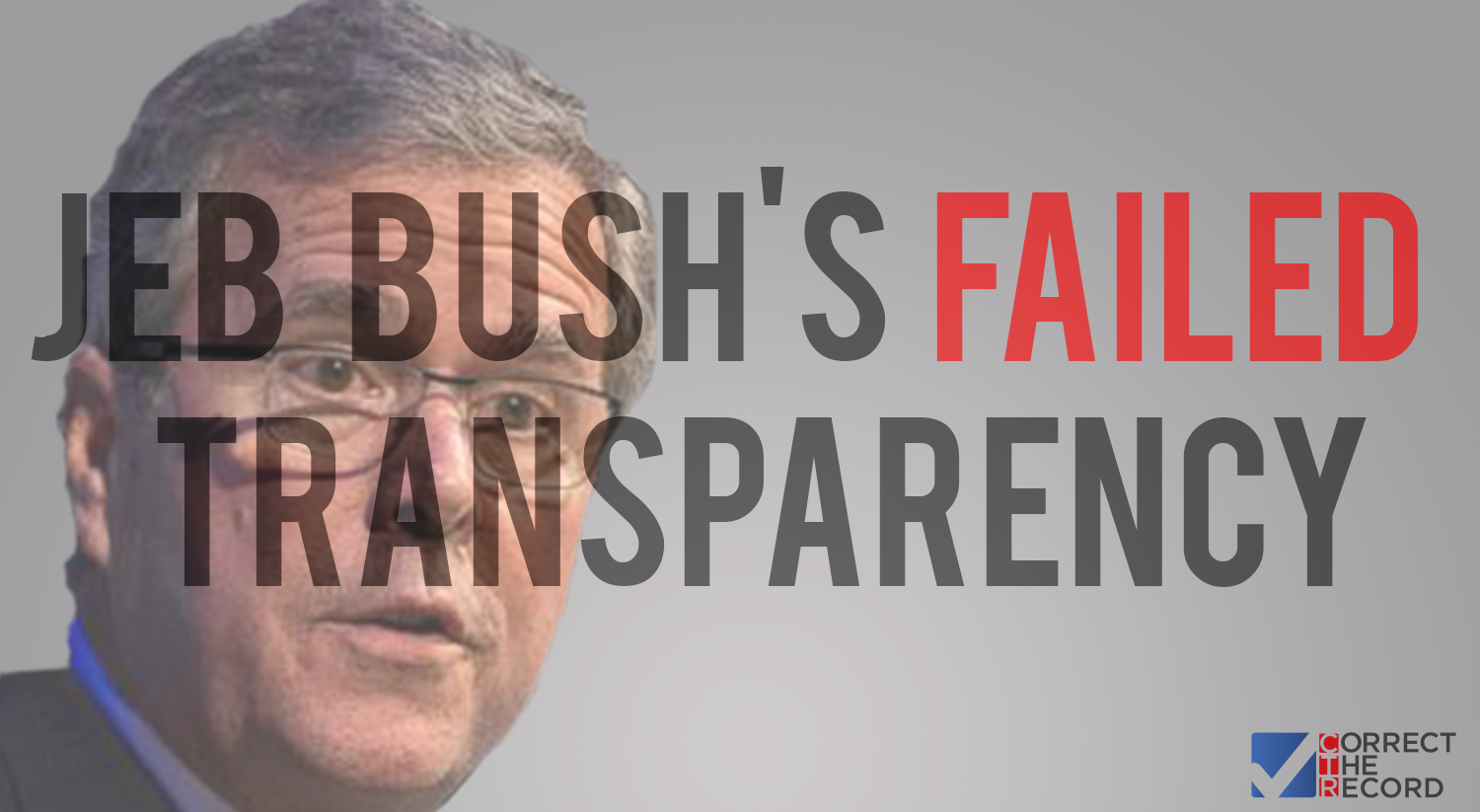
Yesterday, Jeb Bush’s Right To Rise PAC released a video comparing his and Hillary Clinton’s records on transparency. This line of attack is an odd choice for Jeb, considering his own record on email transparency fails to measure up. While in an unprecedented move for a Secretary of State, Hillary Clinton has proactively called for all her work-related emails to be released to the public, Jeb Bush only released some of his emails as governor, and because he was actually forced to by state law.
Though Jeb! touts the importance of transparency frequently as a presidential candidate, he has a long history in Florida, as reported over the past decade by Florida press, of not being as transparent as he would like folks to believe. Jeb’s newfound interest in “transparency” is nothing more than a failed attempt to obscure his own poor record.
JEB BUSH’S POOR RECORD ON TRANSPARENCY
Jeb Bush used a private email account and hand selected emails to disclose
Jeb Bush was required under Florida law to release all e-mails related to his time in office. “Bush rebuffed such criticism during an event in New Hampshire on Friday. ‘I’m not surprised that the Clinton operatives would suggest this. It’s kind of standard operating procedure,’ he told reporters, referring to Democratic charges that his e-mail situation was no different than Clinton’s. He added later that he was ‘totally transparent. I have a BlackBerry as part of my official portrait, for crying out loud. There was nothing to hide.’ Under Florida law, Bush was required to hand over e-mails related to his time in office. Bush aides say there were about 550,000 e-mails on Bush’s server when he left office in 2007, although a portion of those came from before he began his tenure. About half that number were eventually turned over to state archives.” [Washington Post, 3/14/15, Florida Code 119.021(4)(a)]
Jeb Bush conducted all his communication on his private [email protected] account and hand selected which emails to turn over to the state archive. “The former governor conducted all his communication on his private [email protected] account and turned over the hand-selected batch to the state archives when he left office. Absent from the stash are emails the governor deemed not relevant to the public record: those relating to politics, fundraising and personal matters while he was governor. Compared to Scott, however, who rarely communicates by email, the contrast is stark.” [Tampa Bay Times, 1/3/15]
Jeb Bush released his private emails from the state archive, but the files were “not complete.” “The Bush files, though enormous, are not complete, however.” [Tampa Bay Times, 1/3/15]
As governor, Jeb Bush had three email accounts, including [email protected] . “In three follow-up e-mails (which Bush also answers promptly), the governor reveals: He has three e-mail accounts, receives 200 to 300 a day [email protected] reads most of them. He guesses that 25 percent of the e-mails come from colleagues, 50 percent from constituents, 10 percent from family and friends and 15 percent from junk mail and list mail. The risk, he says, is in relying too much on e-mail, at the expense of face-to-face nuance. ‘There is always [the] threat of invading family time!’ he writes.” [The Washington Post, 2/21/03]
- Bush continued to use the private [email protected] email after leaving office. [Email from Jeb Bush To Matt Castner, 6/5/08]
- Bush estimated 25 percent of email traffic came from colleagues. “In three follow-up e-mails (which Bush also answers promptly), the governor reveals: He has three e-mail accounts, receives 200 to 300 a day [email protected] reads most of them. He guesses that 25 percent of the e-mails come from colleagues, 50 percent from constituents, 10 percent from family and friends and 15 percent from junk mail and list mail. The risk, he says, is in relying too much on e-mail, at the expense of face-to-face nuance. ‘There is always [the] threat of invading family time!’ he writes.” [The Washington Post, 2/21/03]
Jeb Bush received 550,000 personal emails
Jeb Bush said “I received 550,000 personal e-mails when I was governor.” “This BlackBerry was in the portrait done when I left office. It was a symbol of how I worked. I received 550,000 personal e-mails when I was governor.” [Esquire, 12/22/08]
Jeb Bush said he received 550,000 e-mails on his private account during his eight years as governor. “Jeb Bush learned plenty during his eight years as Florida governor, he told a crowd at a United Christian Giving fundraiser in Fort Myers on Thursday. The president’s little brother and former president’s son took few partisan shots, mostly entertaining the crowd with stories from ‘Mount Tallahassee.’ […] Bush said he got 550,000 e-mails on his private account and another 2.5 million on his public account during his eight years as governor.” [Naples Daily News, 7/12/07]
Jeb Bush said he received 2.5 million e-mails on his public account during his eight years as governor. “Bush said he got 550,000 e-mails on his private account and another 2.5 million on his public account during his eight years as governor.” [Naples Daily News, 7/12/07]
Jeb Bush said he would release 250,000 emails
Jeb Bush said he would launch a website to make available about 250,000 e-mails from his time as governor. “Jeb Bush said he would launch a website on Tuesday on which he will make available about 250,000 emails from his time as governor of Florida, as well as the first chapter of an e-book about his administration. The emails, which were obtained by a number of news media organizations through a public records request in December, show Mr. Bush’s style in communicating with both his staff and his constituents.” [New York Times, 2/9/15]
Jeb Bush said he would release 250,000 emails from his two terms in office. “Former Florida Gov. Jeb Bush said on Sunday he will release 250,000 emails from his two terms in office and write an eBook outlining his governing philosophy. The moves have set the political sphere atwitter with speculation he’s closer than ever to deciding to run for president in 2016. In what appears to be a move of classic political procedure — getting ahead of the opposition — Bush told WPLG-TV that his intention is to promote transparency.” [CNN, 12/31/14]
Jeb Bush’s Opaqueness
2006 St. Petersburg Times editorial: “Some state agencies during Gov. Jeb Bush’s tenure have not been as responsive as they should be” about making records public. “Gov.-elect Charlie Crist has demonstrated this week that his commitment to open government and well-run elections, two areas where Florida could stand some improvement, extends well beyond political rhetoric. His creation of the Office of Open Government and his appointment of Pasco Supervisor of Elections Kurt Browning as secretary of state are excellent steps toward reasserting the importance of two core values essential to democracy. Some state agencies during Gov. Jeb Bush’s tenure have not been as responsive as they should be about providing the public with records and basic information that should not be secret. Bush’s office has been known to keep close daily track of which reporters are requesting what information from which state agency, and at times the approach in Tallahassee has been to stall as long as possible and then release records grudgingly. The Legislature, meanwhile, has been busy carving out as many exemptions to the public records laws as possible.” [Editorial, St. Petersburg Times, 12/15/06]
Morgan: On his first full day in office, “Gov. Jeb Bush refused to produce copies of his daily calendar – a public record under Florida law.” According to an op-ed by Lucy Morgan in the St. Petersburg Times, “The contrast couldn’t be more striking. On his first full day in office, Gov. Charlie Crist invited reporters into his private office and signed his very first executive order creating an Office of Open Government. Eight years ago on his very first full day in office, Gov. Jeb Bush refused to produce copies of his daily calendar – a public record under Florida law. When pressed, his staff released a calendar that said ‘office hours,’ omitting the customary names of those who might be on the schedule to meet with the governor.” [Morgan, St. Petersburg Times, 1/5/07]
Morgan: Gov. Jeb Bush “made it extremely difficult for anyone to get possession of a public record from his office, frequently stalling for months.” According to an op-ed by Lucy Morgan in the St. Petersburg Times, “Bush tangled with reporters from the minute he was elected, refusing at first to release copies of transition records. Once in office, Bush made it extremely difficult for anyone to get possession of a public record from his office, frequently stalling for months before even routine documents were produced. Crist’s staff routinely released transition records, including requests from people seeking jobs. Bush waited until inaugural events were long over before releasing a list of who made contributions to pay for them. Crist released the names of contributors as the checks came in, posting them on the transition Web site.” [Morgan, St. Petersburg Times, 1/5/07]
St. Petersburg Times editorial: Gov. Jeb Bush’s office was “the only state agency that failed to comply” with the Florida public records law in a 2004 audit. “Four out of 10 government agencies failed to fully comply with the public records law in a recent audit conducted by 30 Florida newspapers, including the St. Petersburg Times. Those in charge of the documents used a variety of tactics to deny or delay the requests, by requiring that they be in writing, forcing the people asking for documents to identify themselves or, in one case, attempting to intimidate the person asking to see a record. […] Document caretakers frequently required the volunteers to identify themselves, state a purpose or make the request in writing (none of which is appropriate under the law). A few government officials attempted to intimidate those seeking a public record. Broward County administrator Roger Desjarlais threatened the person asking to see his office e-mails by saying, ‘I can make your life very difficult.’ Even Gov. Jeb Bush’s office – the only state agency that failed to comply with the law – required a form to be filled out before acceding to a public records request.” [Editorial, St. Petersburg Times, 2/10/04]
Gov. Jeb Bush met privately with top state officials to discuss tax cuts, Senate confirmations, and the state budget on his first full day in office, refusing to let reporters listen in. “On his first full day in office, Gov. Jeb Bush met with the two most powerful public officials in Florida’s Legislature, but the meetings weren’t public. Bush’s staff refused to let reporters in to listen as he chatted with House Speaker John Thrasher and Senate President Toni Jennings. The governor and his aides said the sessions were little more than ‘courtesy calls,’ but later they acknowledged they discussed tax cuts, Senate confirmation of appointments and the state’s multibillion-dollar budget. Florida’s Constitution requires meetings between the state’s top officials, where ‘pending legislation’ or ‘formal legislation’ is discussed, to be open.” [St. Petersburg Times, 1/7/99]
- The Florida Constitution requires that meetings between top state officials over “pending legislation” or “formal legislation” be open.“On his first full day in office, Gov. Jeb Bush met with the two most powerful public officials in Florida’s Legislature, but the meetings weren’t public. Bush’s staff refused to let reporters in to listen as he chatted with House Speaker John Thrasher and Senate President Toni Jennings. The governor and his aides said the sessions were little more than ‘courtesy calls,’ but later they acknowledged they discussed tax cuts, Senate confirmation of appointments and the state’s multibillion-dollar budget. Florida’s Constitution requires meetings between the state’s top officials, where ‘pending legislation’ or ‘formal legislation’ is discussed, to be open.” [St. Petersburg Times, 1/7/99]
- Bush initially said that the meetings were “courtesy calls,” only later admitting that government business was discussed.“On his first full day in office, Gov. Jeb Bush met with the two most powerful public officials in Florida’s Legislature, but the meetings weren’t public. Bush’s staff refused to let reporters in to listen as he chatted with House Speaker John Thrasher and Senate President Toni Jennings. The governor and his aides said the sessions were little more than ‘courtesy calls,’ but later they acknowledged they discussed tax cuts, Senate confirmation of appointments and the state’s multibillion-dollar budget. Florida’s Constitution requires meetings between the state’s top officials, where ‘pending legislation’ or ‘formal legislation’ is discussed, to be open.” [St. Petersburg Times, 1/7/99]
After winning the gubernatorial election, Jeb Bush claimed that his transition materials were not subject to public records laws because he was still a private citizen. “Bush, who had never held elected office until he was sworn in Tuesday, must get used to working under a microscope. Gone are the campaign days, when he could strategize with his political team and orchestrate events for the cameras. He tussled with some reporters soon after winning the election, claiming that his transition work was not subject to public records laws because he was still a private citizen. At the time, he promised things would be different once he took office, saying he intends to be more open than past governors.” [St. Petersburg Times, 1/7/99]