

Background: An article on the Clinton Foundation published June 27 in the magazine “The Week” contained significant misinformation regarding the Clinton Foundation. The author cited myths perpetuated in a now widely discredited book, “Clinton Cash,” which was written by Peter Schweizer, a former advisor to Sarah Palin. The article also contained a number of inaccurate and misleading claims without sourcing.
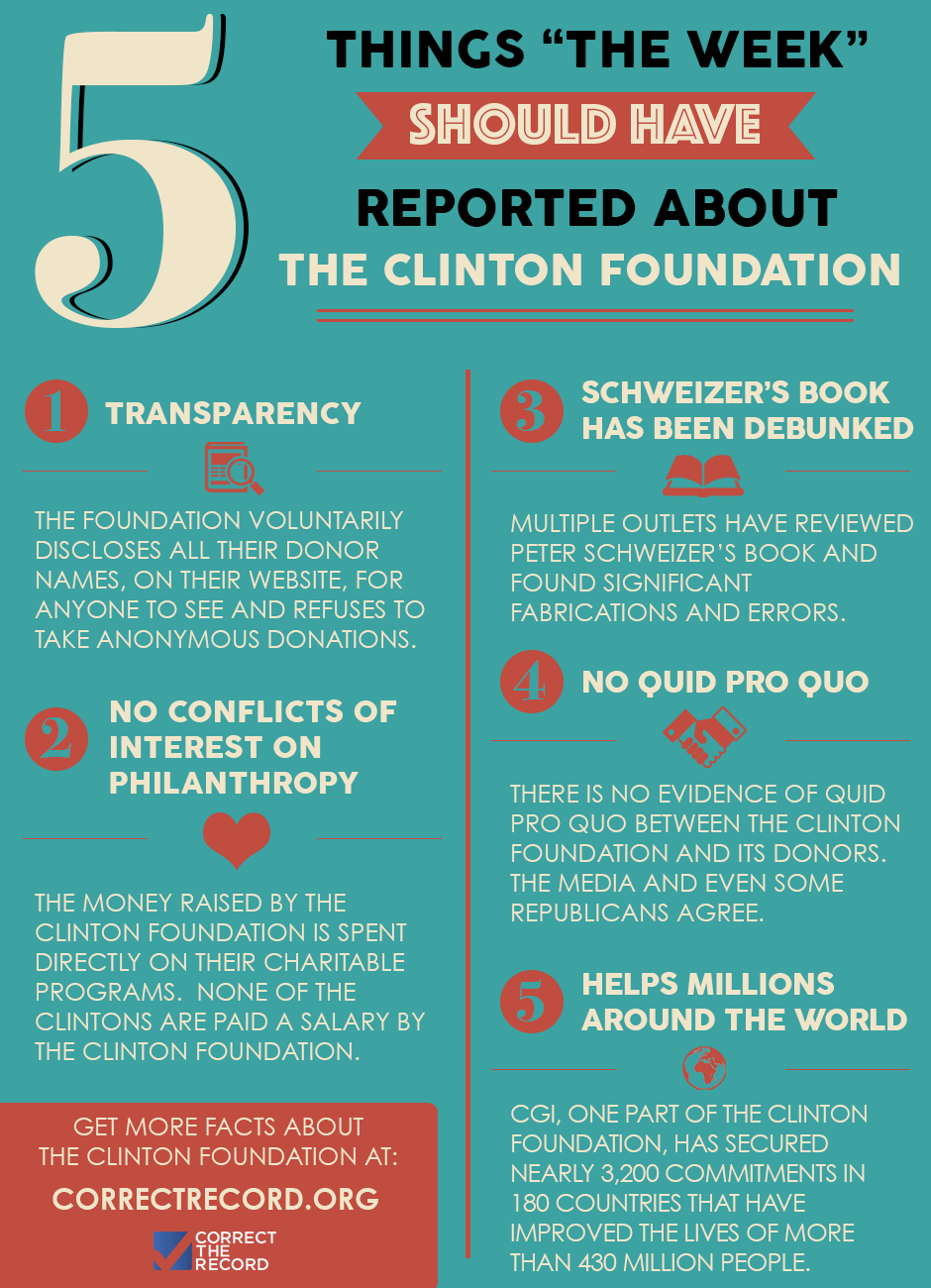
Here are five things “The Week” should have reported about the Clinton Foundation:
1. Transparency
The Clinton Foundation goes above and beyond what is required to ensure transparency in contributions. The reason that reporters know about Clinton Foundation donors is because the Foundation voluntarily discloses all their donor names, on their website, for anyone to see. The Clinton Foundation refuses to take anonymous donations. No charity is required to do this but the Clinton Foundation does it on its own accord. We’re not the only ones saying it:
- “In posting its donor data, the foundation goes beyond legal requirements, and experts say its transparency level exceeds that of most philanthropies.” (Washington Post, 2/18/15)
- “So here’s a fact that should start appearing in news accounts and essays: In the world of big American philanthropy, the Clinton Foundation is remarkably transparent.” (Forbes, 4/26/15)
2. No conflicts of interest on philanthropy
The Clinton Foundation is a global philanthropy. As with other charities, it receives donations from around the world because it is working to improve the lives of millions. As Bill Clinton said, “We ought to bring people together across great divides, around things that they can agree on and find something to do to make people’s lives better.”
While Republican operatives and pundits continue to attack the good works of the Clinton Foundation, claiming that charitable efforts create conflicts of interest, the Foundation is continuing to provide people in the developing world with access to lifesaving HIV/AIDs treatment, lower the cost of malaria drugs, and provide vaccines to children to prevent child death.
The money raised by the Clinton Foundation is spent directly on their charitable programs, with a majority of the work being performed and implemented by staff and partners on the ground. In fact, The American Institute of Philanthropy’s Charity Watch did an analysis of Clinton Foundation funding and concluded that about 89% of its funding went to charity.
None of the Clintons have ever taken a salary from the Clinton Foundation. According to the Foundation’s website, “President Clinton and Chelsea Clinton, who serve on the Board of Directors, do not take a salary from the Clinton Foundation and receive no funding from it. Secretary Clinton did not take a salary when she served on the Board of Directors.”
3. Schweizer’s book has been debunked
Multiple outlets have reviewed Peter Schweizer’s book and found significant fabrications and errors. Schweizer’s work of fiction should not be cited in a news article as fact.
- An independent review of source material by ABC News uncovered errors in “Clinton Cash.”
- Politico wrote that “Clinton Cash” “presents little evidence” that Sec. Clinton’s support of the U.S.-Colombia free trade deal “was directly linked to [Frank] Giustra’s contributions.”
- TIME found that the book’s “suggestion of outside influence over U.S. decision making” with regards to the purchase of American uranium mines by a Russian-backed company “is based on little evidence.”
4. There is no quid pro quo
There is no evidence of quid pro quo between the Clinton Foundation and its donors. The media and even some Republicans agree:
- The Hill reported that “Even Schweizer admits he has no smoking gun proving that either Hillary Clinton or former President Bill Clinton sought to further the interests of donors to the Clinton Foundation in improper ways.”
- Vox wrote that Schweizer “couldn’t prove – or even assert – that Hillary Clinton took any official action because of contributions to the Clinton Foundation.”
- Arkansas’ Republican Governor Asa Hutchinson told The Hill that “there’s no evidence of quid pro quo.”
5. Helping millions around the world
President Clinton formed the Clinton Foundation because he wanted to address global challenges and make the world a better place. In his farewell address as President, Clinton discussed how, by building partnerships, the Foundation could help improve the lives of billions around the world. It has already positively impacted millions of people. For example, since its inception, the Clinton Global Initiative has secured nearly 3,200 commitments in 180 countries that have already improved the lives of more than 430 million people, and that’s just one part of the Clinton Foundation.