

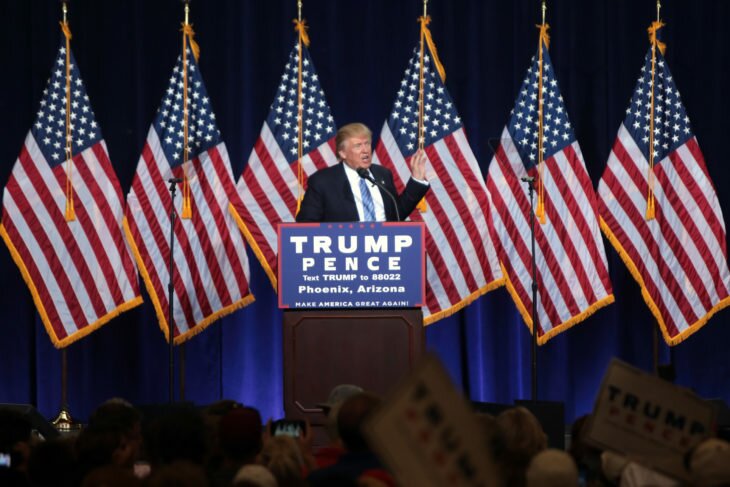
The plot has thickened in the Donald Trump-Pam Bondi scandal. The New York Times reported that the $25,000 donation from his Foundation to support Bondi’s reelection (in violation of federal law) isn’t even Trump’s first brush with campaign donation violations. The Huffington Post reported that Bondi got not only the $25K from Trump–she got a deal on the Mar-a-Lago as the site for a campaign fundraiser. Cheaper than The Donald charges his campaign!
As The New York Times editorialized, “there’s little doubt they abused the public trust” and if the pay-to-play happened on their phone call, “it could be a crime.” What is coming next?
New York Times: Donald Trump’s Donation Is His Latest Brush With Campaign Fund Limits
By Steven Eder and Megan Twohey
September 6, 2016
Donald J. Trump, who has repeatedly denounced pay-to-play politics during his insurgent campaign, is now defending himself against claims that he donated $25,000 to a group supporting the Florida attorney general, Pam Bondi, to sway her office’s review of fraud allegations at Trump University.
Mr. Trump’s payment of a $2,500 penalty to the Internal Revenue Service over that 2013 campaign gift amounted to only the latest slap of his wrist in a decades-long record of shattering political donation limits and circumventing the rules governing contributions and lobbying.
In the 1980s, Mr. Trump was compelled to testify under oath before New York State officials after he directed tens of thousands of dollars to the president of the New York City Council through a myriad subsidiary companies to evade contribution limits. In the 1990s, the Federal Election Commission fined Mr. Trump for exceeding the annual limit on campaign contributions by $47,050, the largest violation in a single year. And in 2000, the New York State lobbying commission imposed a $250,000 fine for Mr. Trump’s failing to disclose the full extent of his lobbying of state legislators.
For the most part, Mr. Trump has seemed unrepentant. Testifying in 1988 about a $50,000 bank loan he had first guaranteed, and then repaid, on behalf of Andrew J. Stein’s successful campaign for New York City Council president, Mr. Trump made no bones about the move.
“I was under the impression that I was getting my money back,” he told the New York State Commission on Government Integrity.
In the Florida case, Mr. Trump is accused of using a large and timely political donation in 2013 to ward off a potentially thorny investigation by Ms. Bondi’s office: Days before the donation was made, The Orlando Sentinel reported that the New York State attorney general’s office had sued Trump University and noted that Ms. Bondi’s office was weighing whether to join in that litigation.
A political aide to Ms. Bondi told The Associated Press earlier this year that the attorney general had solicited the donation in a conversation with Mr. Trump weeks before the Sentinel’s article. But Mr. Trump made the donation from his charitable foundation, in violation of tax regulations, and paid the penalty, as first reported by The Washington Post reported last week.
Mr. Trump and Ms. Bondi, who is supporting his campaign, have denied any connection between his donation and her office’s decision not to proceed with an investigation. Asked about the subject on Monday, he called Ms. Bondi “beyond reproach” and said he “never spoke to her about that at all.”
A spokesman for the Florida attorney general’s office, Gerald Whitney Ray, said the office’s inquiry never came across Ms. Bondi’s desk: Lower-level staff members made the decision not to proceed with an investigation of their own. Mr. Ray also said the office never gave any thought to joining in the New York attorney general’s case.
But Democrats and liberal watchdogs seized the opportunity to accuse Mr. Trump of practicing exactly the sort of corrupt politics that he rails against on the campaign trail.
Campaigning in Tampa, Fla., on Tuesday, Hillary Clinton demanded details of the conversation in which Ms. Bondi solicited Mr. Trump’s donation. “The American people deserve to know what was said, because clearly the attorney general did not proceed with the investigation,” she told reporters.
And Jordan Libowitz, a spokesman for the liberal-leaning Citizens for Responsibility and Ethics in Washington, said Mr. Trump’s donation to Ms. Bondi gave new meaning to his more recent boasts about the efficacy of his political giving. “It sure looks like that is what is going on here,” said Mr. Libowitz, whose group filed a complaint about the donation with the I.R.S.
Though Mr. Trump denies it in the case of Ms. Bondi, he has been brazen in asserting that he has used political donations to buy influence — and routinely asks voters to trust that, because he possesses that insider’s knowledge, he can reform a system that he calls “rigged.”
A political aide to Ms. Bondi told The Associated Press earlier this year that the attorney general had solicited the donation in a conversation with Mr. Trump weeks before the Sentinel’s article. But Mr. Trump made the donation from his charitable foundation, in violation of tax regulations, and paid the penalty, as first reported by The Washington Post reported last week.
Mr. Trump and Ms. Bondi, who is supporting his campaign, have denied any connection between his donation and her office’s decision not to proceed with an investigation. Asked about the subject on Monday, he called Ms. Bondi “beyond reproach” and said he “never spoke to her about that at all.”
A spokesman for the Florida attorney general’s office, Gerald Whitney Ray, said the office’s inquiry never came across Ms. Bondi’s desk: Lower-level staff members made the decision not to proceed with an investigation of their own. Mr. Ray also said the office never gave any thought to joining in the New York attorney general’s case.
But Democrats and liberal watchdogs seized the opportunity to accuse Mr. Trump of practicing exactly the sort of corrupt politics that he rails against on the campaign trail.
Campaigning in Tampa, Fla., on Tuesday, Hillary Clinton demanded details of the conversation in which Ms. Bondi solicited Mr. Trump’s donation. “The American people deserve to know what was said, because clearly the attorney general did not proceed with the investigation,” she told reporters.
And Jordan Libowitz, a spokesman for the liberal-leaning Citizens for Responsibility and Ethics in Washington, said Mr. Trump’s donation to Ms. Bondi gave new meaning to his more recent boasts about the efficacy of his political giving. “It sure looks like that is what is going on here,” said Mr. Libowitz, whose group filed a complaint about the donation with the I.R.S.
Though Mr. Trump denies it in the case of Ms. Bondi, he has been brazen in asserting that he has used political donations to buy influence — and routinely asks voters to trust that, because he possesses that insider’s knowledge, he can reform a system that he calls “rigged.”
During a Republican debate last summer, Mr. Trump responded about his ability to curry favor with public officials when he was confronted with one of his own statements: “When you give, they do whatever the hell you want them to do.”
“You’d better believe it,” Mr. Trump responded. He added: “When they call, I give. And you know what? When I need something from them two years later, three years later, I call them, they are there for me.”
Indeed, Mr. Trump’s history of political giving stretches back decades — and has repeatedly drawn regulatory scrutiny.
When a New York State commission investigated contributions to state and local officials in the 1980s, it subpoenaed Mr. Trump, who had contributed $150,000 to candidates in 1985. Under oath, he said he had circumvented the state’s $50,000 individual and $5,000 corporate contribution limits by disbursing his contributions to Mr. Stein, the city councilman, through 18 subsidiary companies.
“My attorneys basically said that this was a proper way of doing it,” Mr. Trump testified.
In an interview, Mr. Stein said he did not recall what Mr. Trump had sought in return for his contributions, or for a $50,000 campaign loan that Mr. Trump first guaranteed and then repaid. He denied ever agreeing to do Mr. Trump any favors.
Years later, Mr. Trump came under fire from the Federal Election Commission for violating a $25,000 annual limit on contributions in the late 1980s. Mr. Trump resisted paying a fine, insisting that he had been unaware of the federal limit and that, once informed of it, he sought refunds.
Only when the commission threatened to take him to court did Mr. Trump agree to a $15,000 civil penalty, records show.
It was with similar reluctance that in 2000, Mr. Trump apologized for failing to disclose to New York State officials that he had spent $150,000 to finance ads opposing a proposed casino in the Catskills, which he saw as a threat to his Atlantic City properties. The ads were created and placed by a political consultant, Roger Stone, and appeared under the name of a front group, the Institute for Law and Society.
A settlement led to what, at the time, was the largest penalty imposed by the state lobbying commission: Trump Hotels and Casino Resorts paid $50,000, and Mr. Stone and the front group each paid $100,000, without admitting wrongdoing. In a statement, all three said they “apologize if anyone was misled.”
In recent years, Mr. Trump has made tens of thousands of dollars in contributions to at least four state attorneys general — Ms. Bondi of Florida and Greg Abbott of Texas, both Republicans, and the Democrats Eric Schneiderman of New York and Kamala Harris of California — whose offices have looked into complaints about Trump University.
Mr. Abbott, whose office considered a lawsuit against Trump University before the company left Texas in 2010, is now supporting Mr. Trump — who donated $35,000 to Mr. Abbott’s successful 2014 campaign for governor.
Ms. Harris’s office said it, too, was investigating the company, and an aide said she donated the $6,000 from Mr. Trump to charity.
Mr. Schneiderman’s fraud lawsuit is still pending. But Mr. Trump, whose donation of $12,500 to Mr. Schneiderman preceded his election, filed a state ethics complaint alleging that Mr. Schneiderman continued to seek donations, calling the fraud case a “shakedown.”
The state ethics panel declined last year to pursue Mr. Trump’s complaint.
New York Times: Editorial: Pay to Play, Mr. Trump?
September 6, 2016
In light of the suspicions hanging over Donald Trump and Pam Bondi, the Florida attorney general, this opening quote from her Republican National Convention speech is particularly rich. “Nov. 8 is a day of reckoning for all those who have abused their power,” she said. “Winning this election means reclaiming something to which I’ve dedicated my entire career: the rule of law.”
While it hasn’t been proved that Mr. Trump or Ms. Bondi violated bribery law, there’s little doubt that they abused the public trust in 2013, when Ms. Bondi received a $25,000 campaign contribution from Mr. Trump four days after her office announced that Florida was “reviewing the allegations” in a lawsuit filed in New York against his Trump University. Attorneys general in New York and California are pursuing separate class-action suits alleging that Trump University bilked consumers of tens of thousands of dollars they each paid for a worthless real-estate investment course. In the end, Ms. Bondi’s office did not take any action against Trump University.
Mr. Trump’s contribution from his family foundation to Ms. Bondi violated federal tax law barring tax-exempt charities from engaging in political activity. The Washington Post reported last week that Mr. Trump paid a $2,500 penalty to the Internal Revenue Service for the violation.
News of the fine came as Mr. Trump has spent days accusing Hillary Clinton and the Clinton Foundation of similar pay-to-play schemes. Confronted on Monday, Mr. Trump said oddly that he hadn’t spoken to Ms. Bondi. The Associated Press reported in June that an adviser to Ms. Bondi confirmed that Ms. Bondi had spoken to Mr. Trump and asked for the contribution.
Mr. Trump has made a point of saying that he’s in the habit of buying politicians. He said in July 2015, “When you give, they do whatever the hell you want them to do.” And during a Republican debate the next month, he said: “I was a businessman. I give to everybody. When they call, I give. And you know what? When I need something from them, two years later, three years later, I call them, and they are there for me.” In Iowa in January, he said: “When I call, they kiss my ass. O.K.?”
Ms. Bondi’s office did not respond when asked for an explanation of why she would accept a $25,000 donation from Mr. Trump just days after her office announced that it was reviewing New York’s allegations against him.
The Florida allegations are not the first of their kind. In 2013 and 2014, Mr. Trump gave a total of $35,000 to the campaign of Greg Abbott, Texas’ attorney general, now the state’s governor. In 2010, Mr. Abbott’s office had dropped its investigation of Trump University. A 2014 series in The Times recounted in detail how many attorneys general, including Ms. Bondi, accepted travel, luxury accommodations and other perks from corporations targeted by their offices. This behavior is practically built into a campaign finance system in which nearly limitless cash engulfs both parties.
If Ms. Bondi promised to back off the Trump University suit in exchange for campaign money during that 2013 phone conversation, it could be a crime. As for Mr. Trump, the $2,500 I.R.S. fine is a tiny penalty, unless voters impose consequences of their own.
Huffington Post: Trump Held Fundraiser For Pam Bondi At Mar-a-Lago After She Dropped Investigation
By Christina Wilkie, Ben Walsh, Dana Liebelson, Sam Stein
9/6/16 10:30 p.m. ET
WASHINGTON ― In March 2014, Donald Trump opened his 126-room Palm Beach resort, Mar-a-Lago, for a $3,000-per-person fundraiser for Pam Bondi, the Florida attorney general who had recently decided not to investigate Trump University and was facing a tough re-election campaign.
Trump, whose personal foundation had given $25,000 to a pro-Bondi group the previous fall, did not write a check to the attorney general that night. But by hosting her at Mar-a-Lago and bringing in some of his own high-profile Florida contacts, he provided her campaign with a nice financial boost.
Trump has claimed that Bondi was merely a candidate he knew well and supported politically. But his fundraising efforts were extensive: In addition to the $25,000 donation, Trump and his daughter Ivanka gave $500 each to Bondi in the fall of 2013. The following year, Ivanka and her father donated a total of $125,000 to the Republican Party of Florida.
All this monetary effort could suggest that Donald Trump was thanking Bondi for not probing his failed seminar program. His efforts to boost her politically came during and after a period when she was being publicly pressed to investigate claims that get-rich-quick seminars bearing his name were defrauding participants.
The use of Mar-a-Lago alone was a donation of some value. Space at the resort is expensive to rent. Trump has charged his own presidential campaign roughly $140,000 an event for use of the resort.
In contrast, the Republican Party of Florida paid only $4,855.65 for the Bondi fundraiser, cutting a check on March 25, 2014. It was a “small event on the lawn … featuring snacks and refreshments, attended by about 50 people,” a Bondi campaign staffer told The Huffington Post.
Trump’s courtship of Bondi, including the Mar-a-Lago event, could complicate a line of attack his campaign is currently making against Hillary Clinton. Trump and his surrogates have attacked Clinton’s family foundation for accepting donations from governments and individuals with business before the State Department during her tenure there. They have suggested that, in turn, those donors were given special access to then-Secretary of State Clinton and her staff.
Clinton and her aides have denied that charge and responded by arguing that Trump has used his money to influence politicians ― an accusation that he hasn’t always denied.
“I’ve got to give [campaign contributions] to them, because when I want something, I get it,” he said in January. “When I call, they kiss my ass. It’s true. They kiss my ass. It’s true.”
Complaints against Trump University and its predecessor Trump Institute began before Bondi took office in 2011. Her predecessor as Florida attorney general, Bill McCollum, had received numerous complaints from attendees of the Trump Institute. According to those attendees, the institute had promised classes and mentoring that never materialized, and when customers complained, it refused to give refunds.
Not everybody was unhappy with the attorney general’s response at that point. One attendee, Sheila Roberts, contacted McCollum’s office in 2009 when she did not receive a refund of almost $2,000. Roberts told The Huffington Post that she felt the office handled her complaint appropriately.
“I did get my money back, so no problem there,” she said. Roberts added that she is voting for Trump.
But for many unhappy customers of the real estate seminars, refunds were few and far between.
Carol Minto of Connecticut said the Trump Institute, which is based in Florida, refused to honor her refund. She reported the matter to both the Florida and Connecticut attorneys general, but only heard back from the latter, who helped her get her money back.
“Trump holds himself out to be this great person in real estate, and I wanted to learn how I could buy and sell properties just like him,” Minto told HuffPost. “And he didn’t even turn up. He just had a picture of himself [at the seminar].”
When Bondi was elected attorney general, the broader question of what to do about all the Trump Institute complaints ― and whether Florida could or should join impending lawsuits ― hadn’t been resolved. As late as September 2013, Bondi’s spokesman said that she would look into the allegations “to see if they have any relevance in Florida.”
But around that time, Bondi personally solicited Trump for a political donation. The real estate mogul’s charitable foundation responded by writing the $25,000 check to a Bondi-backing group named And Justice For All. (The check proved to be a violation of Internal Revenue Service rules for tax-exempt nonprofits. Trump recently paid a $2,500 penalty.)
Florida resident Kenneth Lafrate claims that the Trump Institute scammed him out of roughly $7,000, most of which paid for a mentoring program. He said he spoke to a mentor online “for a number of months,” until the mentor abruptly stopped answering messages. Lafrate contacted the Florida attorney general’s office as early as 2008 but said he did not receive a response. When he later learned of Trump’s connection to Bondi through news reports, he stopped expecting to get assistance.
“She’s not going to do anything because she’s kind of in with [him],” he told HuffPost.
Lafrate said he also notified New York Attorney General Eric Schneiderman, who filed a fraud suit against Trump in 2013, and received “a nice letter saying that they were aggressively pursuing this.”
Another Trump Institute attendee, Mitzie Andrade of Connecticut, reached out to the Florida attorney general’s office in 2008 in an attempt to get a refund on the more than $3,000 she had paid. Andrade told HuffPost that she heard back from McCollum’s office and eventually received her money.
“I got everything back. I was lucky, I guess,” Andrade said. “Some people weren’t as lucky, I’m sure. It is not a real seminar, it is a scam. It is a downright scam.”
Trump has pushed back against criticism of his seminar programs for years, in part by offering up positive reviews by some attendees. To this day, the first entry on the “Issues” page of Trump’s presidential campaign website is a video of people insisting that Trump University was not a scam. It’s worth noting, however, that none of these positive reviewers are descibed as working in the real estate business that the institute claimed to teach them all about.
Bondi’s office did at least some outreach to Trump’s alleged victims. On Oct. 10, 2013, a representative for her office followed up with Harold Stevens, who claimed he first learned about Trump’s seminars from a radio commercial. The representative promised the office was “concerned with all potentially unfair and deceptive trade practices.”
In September 2013, three days before Trump’s foundation donated to the pro-Bondi group, the Orlando Sentinel reported that her office was considering joining the New York lawsuit. But Bondi’s office ultimately did not.
At the time, the Florida attorney general’s office said there was no need to file the state’s own suit, with so many other lawsuits in other states underway.
Florida and New York aren’t the only states where campaign donations appeared to be linked to efforts to quash investigations of Trump. In 2013, the businessman gave $35,000 to then-Texas Attorney General Greg Abbott, after Abbott dropped his probe into Trump University.
A former employee of Trump University, who requested anonymity because he has a nondisclosure agreement, said that politics played a role in decisions by some top state prosecutors.
“All we have to do is stroke a check to the committee to re-elect [the state attorney general],” the individual said. “And the problems go away.”