

Seven years ago today, President Obama signed into law his very first bill—the Lilly Ledbetter Fair Pay Act. As a result, women all across the country now have more power in the fight for equal wages.
Hillary Clinton co-sponsored that bill, and was lead sponsor of the Paycheck Fairness Act in 2005 and 2007. Republicans on Capitol Hill, however – including several seeking their party’s presidential nomination – consistently vote against wage equality. Rand Paul, Ted Cruz, Marco Rubio—we’re looking at you.
These guys aren’t the only ones to uphold the wage gap. As we celebrate this moment in history, let’s not forget that Republican candidates have a history of opposing women’s progress (and one—ahem, Jeb—had never heard of the Paycheck Fairness Act).
THE GOP ON EQUAL PAY
Donald Trump
Donald Trump said equal pay legislation could lead to “an economy where it’s no longer free enterprise economy.” “CUOMO: You said I’m going to be great for women. I will do the most that can be done for women. Will you pass an equal pay? You know the statistics. You know, they don’t get paid what men do? TRUMP: I’m looking into that very strongly. I was asked that question yesterday. I’m looking into it very strongly. I will have a position on it in the not too distant future. One of the problems you have is you get to have an economy where it’s no longer free enterprise economy. You know, everybody gets the saying whether the — the concept of it is good. It’s a very complicated. The whole issue is a very complicated issue.” [CNN’s New Day, 8/11/15]
Ted Cruz
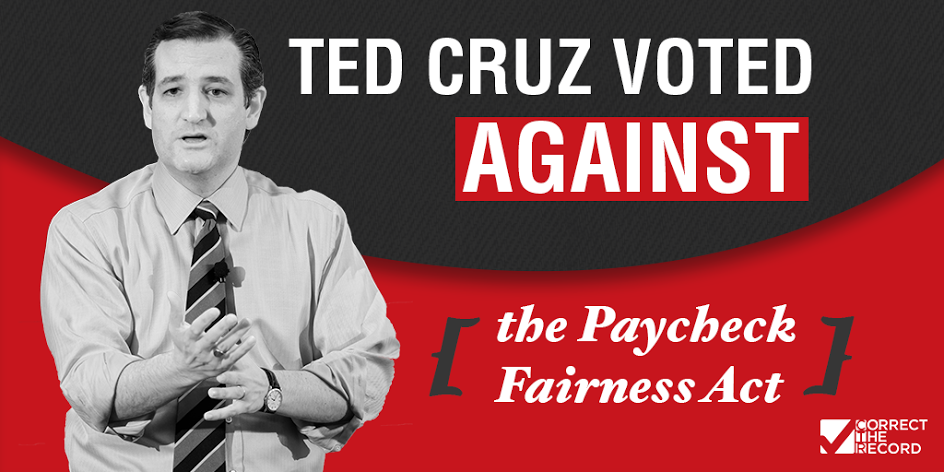
Ted Cruz voted against the Paycheck Fairness Act multiple times. According to the Congressional record, Ted Cruz cast two “nay” votes against the Paycheck Fairness Act, legislation that would strengthen protections for victims of wage discrimination on the basis of sex. [S. 2199, 4/1/14; Senate roll call vote 260, 9/10/14; Senate roll call vote 262, 9/15/14]
Marco Rubio
Marco Rubio said he voted against fair pay legislation because “all it really did is just help lawyers sue.” “The most recent data shows that women who work full time throughout the year make just 79 percent of what men doing the same make, and the gap shows up in virtually every job, every single industry, and at every education level. It’s even wider for women of color. Yet when asked by members of the work/family organization Make It Work why he has voted against the Paycheck Fairness Act multiple times, a bill that would ban salary secrecy and strengthen protections against unequal pay, Republican presidential candidate Sen. Marco Rubio (FL) indicated that the gap shouldn’t even exist today. ‘It’s already illegal to pay women less than men,’ he responded. ‘If I pay a woman less than a man for the same job, it’s illegal now. You can be sued now.’ Though he offered up lawsuits as the remedy for unequal pay, Rubio is against the Paycheck Fairness Act because it would result in more lawsuits. ‘The Paycheck [Fairness] Act, all it did was allow trial lawyers to sue,’ he said. ‘The reason I voted against it is because…all it really did is just help lawyers sue.’” [Think Progress, 11/30/15]
Marco Rubio repeatedly voted against equal pay legislation, calling it “a welfare plan for trial lawyers.” “Republicans, seeking to mitigate the fallout after recent debates over women’s health have cast them in a harsh light among female voters, were careful not to be seen as rooting against the cause of equal pay. Instead, they decried the bill as a political stunt. ‘It’s pure election-year politics,’ said Sen. Marco Rubio (R-FL). ‘This bill reads more to me like some sort of a welfare plan for trial lawyers.’” [Talking Points Memo, 6/5/12; Senate roll call vote 115, 6/5/12; Senate roll call vote 103, 4/9/14; Senate roll call vote 260, 9/10/14; Senate roll call vote 262, 9/15/14]
Marco Rubio claimed the push for fair pay legislation was “about scoring political points.” In an official press release, Rubio said, “Once again, Senate Democrats have wasted the American people’s time by holding yet another show vote that proves any sense of urgency they have is about scoring political points instead of solving the problems that threaten America’s future.” [Official Marco Rubio Press Release, 6/5/12]
Jeb Bush
Jeb Bush: “What’s the Paycheck Fairness Act?” “‘What’s the Paycheck Fairness Act?’ Bush asked, in an exchange captured by the liberal opposition research outfit American Bridge. Once the man he was speaking with defined it as a bill that would ensure that women get ‘equal pay for equal work,’ Bush took issue with his phrasing. ‘Equal pay for the same work, not for equal work — I think that’s the problem with it. I think there’s a definition issue,’ he said, before declining to say whether or not he thought Land should support the legislation.” [The Hill, 10/15/14]
Jeb Bush suggested that existing wage laws were sufficient to ensure equal pay. “‘Wages should be equal, and there are laws to make it so, and they should be enforced,’ Bush said in response to a subsequent question from one female employee, implying he thought that existing statutes were effective at making it so. The employee cited the oft-used statistic that by some measures women are paid 79 percent of what men make for the same work. Bush interrupted her to ask whether that was the case at the startup.” [TIME, 7/16/15]
Chris Christie
Chris Christie vetoed “two sensible reforms that would help prevent women from getting cheated in their paychecks.” “Gov. Chris Christie says he’s committed to pay equity for women. So why, for the second time, has he killed two sensible reforms that would help prevent women from getting cheated in their paychecks? […] One bill, called the Wage Transparency Act, Christie outright vetoed. It would have required state contractors to make their gender, race and wage information publicly available, as federal contractors will soon have to. Christie argues the state’s prevailing wage law already requires wage reporting. But it doesn’t cover all public contractors. And we have yet to see any evidence that doing so would be too ‘costly and burdensome’ for business, as Christie claims. Weinberg’s other bill, the Unfair Wage Recovery Act, Christie’s conditional veto has rendered toothless. Under this reform, a woman who suddenly discovers she is being paid less than male co-workers would have had the opportunity to seek all the back pay she is owed, without hitting an arbitrary statute of limitations.” [Star-Ledger, 8/14/14]
Rand Paul
Rand Paul voted against the Paycheck Fairness Act multiple times and compared equal pay legislation to the Soviet Politburo. “Paul, a staunch libertarian, said passing a law that would have given judges more leeway to determine if a woman had been paid unfairly would be a step toward reviving the Soviet Union’s notorious central governing body here. The United States’ free market, he argued, works much better at setting wages at the appropriate level. ‘Three hundred million people get to vote everyday on what you should be paid or what the price of goods are,’ Paul told reporters on Capitol Hill. ‘In the Soviet Union, the Politburo decided the price of bread, and they either had no bread or too much bread. So setting prices or wages by the government is always a bad idea.’” [Huffington Post, 6/5/12; Senate roll call vote 115, 6/5/12; Senate roll call vote 103, 4/9/14; Senate roll call vote 260, 9/10/14; Senate roll call vote 262, 9/15/14]
Rand Paul: “I think some of the victimology and all of this other stuff is trumped up.” “Sen. Rand Paul said Sunday that Democrats are failing in their attempts to frame the GOP as a party that wages a war against women. ‘The whole thing of the ‘war on women,’ I sort of laughingly say, ‘Yeah, there might have been – but the women are winning it,’’ the Republican senator from Kentucky said on CNN’s ‘State of the Union.’ He said women have made great strides and, as an example, now make up more than half the students at medical and law schools. […] ‘And I think some of the victimology and all of this other stuff is trumped up. We don’t get to any good policy by playing some sort of charade that somehow one party doesn’t care about women or one party is not in favor of women advancing, or other people advancing.’” [CNN, 1/26/14]
John Kasich
John Kasich said the gender wage gap was “based on experience” and “tied up in skills.” “In Washington, D.C. on Tuesday, the U.S. Hispanic Chamber of Commerce (USHCC) grilled presidential candidate John Kasich about his views on immigration, gun control, the wars in the Middle East, and economic inequality — particularly between men and women. USHCC President Javier Palomarez challenged the Ohio governor on the fact that women in his state working full time are getting paid roughly 78 percent of what men make — according to figures released by the U.S. Census Bureau. For Latina women across the U.S., the gap is even greater: just 54 percent of what men made in 2014. Palomarez pointed out that Kasich has daughters of his own, and asked how he explains this disparity to them. ‘Well, a lot of it is based on experience,’ Kasich replied. ‘A lot of different factors go into it. It’s all tied up in skills. Do you not have the skills to be able to compete?’” [Think Progress,10/7/15]
Women working in Gov. John Kasich’s office were paid an average of $9.81 per hour less than men. “A newspaper investigation has found the average pay gap between men and women in the offices of four of Ohio’s five elected statewide officials has grown to as much as almost $10 an hour, as it’s shrunk to under a dollar across the rest of state government. Women working in Republican Gov. John Kasich’s office earn $9.81-an-hour less, on average, than men, the Dayton Daily News analysis published Sunday showed. That’s the highest gender pay gap among statewide officeholders, according to the newspaper’s study of Ohio Department of Administrative Services data. The gender gap compares to $3.99-an-hour under former Gov. Ted Strickland.” [Associated Press, 4/21/14]
Carly Fiorina
Carly Fiorina called equal pay legislation “tokens” and “gestures.” “Fiorina: I think in some cases we just have to take on the facts. There are plenty of laws in place today that a woman can look to if she’s truly discriminated against at work, where she’s actually earning less for the same job as her male counterpart. So the Paycheck Fairness Act, the Lilly Ledbetter Fair Pay Act — these are tokens. They’re gestures. They don’t truly help women advance. We can’t avoid the factual arguments, because they’re on our side. [CNN, 6/30/14]
Rick Santorum
Rick Santorum opposed the Lily Ledbetter Fair Pay Act, calling it “a trial lawyer’s bill.” “As polls show the tightening of a gender gap and the chase by both Romney and Obama for an elusive ‘women’s vote’ that everyone agrees is far from monolithic, Santorum dismissed all the fuss over Romney’s ‘binders full of women’ and the Lilly Ledbetter Fair Pay Act, touted by the president Tuesday and since as the first piece of legislation he signed. ‘It’s very interesting that what Barack Obama pointed to was a trial lawyer’s bill,’ Santorum told me after his brief speech. ‘The Lilly Ledbetter bill basically gives women a longer period of time to file a lawsuit,’ he said. ‘This was advocated by the trial lawyers so they could make more money. This had nothing to do with changing the law with respect to pay for women or rights for women. It simply gave lawyers a longer time to sue. This is the kind of small ball this president is playing. He’s not talking about major issues that can improve the employment picture for women or for people in this country. He’s talking about taking care of his friends in the trial bar.’” [Washington Post, 10/18/12]