

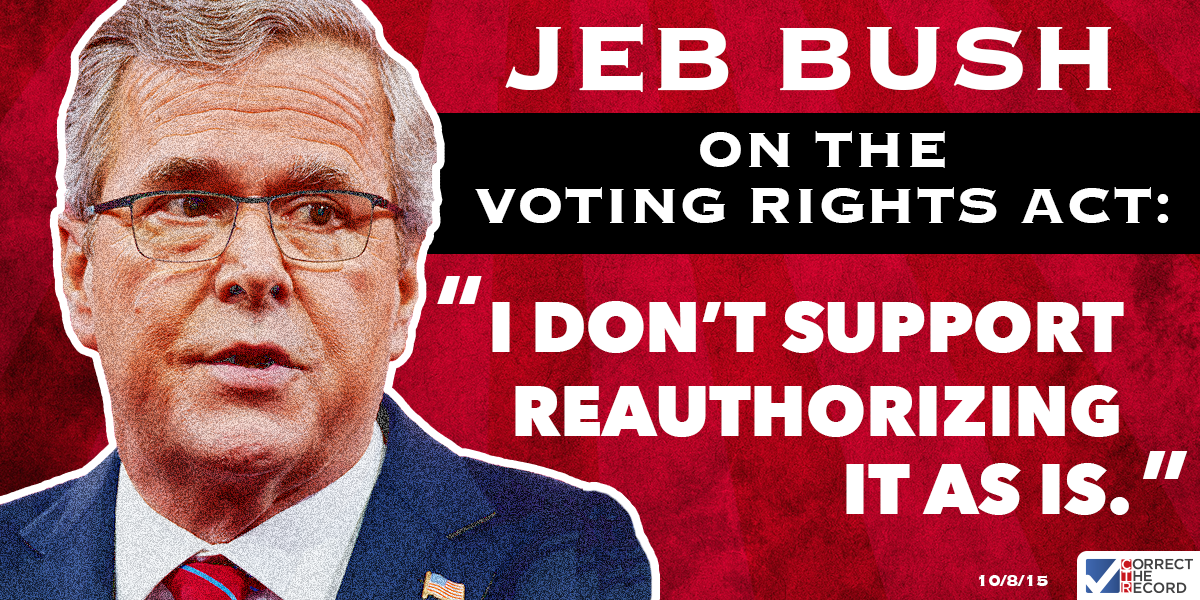
Speaking in Des Moines, Iowa today, Jeb Bush vowed to tear down a landmark piece of legislation that has protected the voting rights of millions of Americans for more than fifty years. Asked about reauthorizing the Voting Rights Act, legislation that has prohibited discrimination in voting places, Bush said “I don’t support reauthorizing it as is,” stating that there has been “dramatic improvement” in access to voting.
Both Jeb’s decision and his justification are flat wrong. In fact, since the 2010 midterm election, 21 states have enacted new laws to restrict voting rights. Over the past few years, Florida has passed voting laws that disenfranchised more than 1.3 million voters in the 2014 gubernatorial election–an election that was decided by only 72,000 votes.
Just this week, after the GOP’s long-waged war on voting rights continued in Alabama, Hillary Clinton expressed outrage, stating: “Just a few years ago, Alabama passed a law requiring citizens to have a photo ID to vote. Now they’re shutting down places where people get those photo IDs. This is only going to make it harder for people to vote.” As Hillary said, this is “a blast from the Jim Crow past.”
That is exactly what Jeb Bush and the entire Republican field represent—a dangerous blast from the past.
The 2016 GOP Record On Voting Rights
Jeb Bush
Jeb Bush on the Voting Rights Act: “I don’t support reauthorizing it as is.” “Jeb Bush thinks the country’s landmark law to prevent discrimination against voters of color has run its course. […] To Bush, singling out states for their historic racism is no longer relevant. ‘If it’s to reauthorize it to continue to provide regulations on top of states as though we are living in 1960—’cause those were basically when many of those rules were put in place—I don’t believe that we should do that,’ he said. ‘There has been dramatic improvement in access to voting. I mean, exponentially better improvement. And I don’t think there is a role for the federal government to play in most places, could be some, but in most places where they did have a constructive role in the ‘60s. So I don’t support reauthorizing it as is.’” [Mother Jones, 10/8/15]
The Jeb Bush administration purged 12,000 eligible voters from the Florida voter rolls ahead of the 2000 presidential election. According to Rolling Stone, “Back in 2000, 12,000 eligible voters – a number twenty-two times larger than George W. Bush’s 537 vote triumph over Al Gore – were wrongly identified as convicted felons and purged from the voting rolls in Florida, according to the Brennan Center for Justice. African Americans, who favored Gore over Bush by 86 points, accounted for 11 percent of the state’s electorate but 41 percent of those purged.” [Rolling Stone, 5/30/12]
Jeb Bush attempted a similar voter purge ahead of the 2004 presidential election. “In May 2004, another presidential election year, Jeb Bush’s administration once again sought to purge its voter rolls of convicted felons. Owing to the previous controversy with DBT, the state Legislature decided that the Department of Elections should create its own list. Once again, the process was flawed. When the list became public in July 2004, a major error became readily apparent: Of the 48,000 people on the new purge list, 22,000 were African Americans but only 61 were Hispanic. African Americans vote heavily Democratic while Hispanics, at that time in Florida, largely voted Republican. This prompted speculation that Jeb Bush’s administration was at best incompetent and at worst, playing politics with its purge list. Facing widespread criticism, it agreed not to use the list.” [Mother Jones, 4/10/15]
Jeb Bush signed into law Florida legislation that restricted the hours and locations for early voting. “Bush and the GOP-led Legislature went the other way the next year, passing a law that capped the number of hours for early voting and confined it to election offices, city halls and libraries.” [Politifact, 11/8/12; House Bill 1567, 5/6/05]
Jeb Bush supported more stringent voter identification laws. In his book, Immigration Wars: Forging an American Solution, Jeb Bush wrote, “Finally, states should be allowed to protect the integrity of the franchise with voter identification laws, which are supported by a large majority of Americans, including Hispanics. So long as states make it simple for citizens to obtain such forms of identification, they should have the latitude to require such identification for voting or to secure welfare benefits.” [Immigration Wars: Forging an American Solution, pg. 38-39, 2013]
Ben Carson
Ben Carson said opponents of voter ID laws were “manipulators.” CARSON: “A classic example of this kind of manipulation is the effort to convince minority voters that anyone advocating officially recognized identification cards is racist, concocting tales of voter fraud. Manipulators will claim that their opponents are trying to suppress the vote by demanding identification cards in areas where they fear they won’t do well electorally.” [Ben Carson, One Vote: Make Your Voice Heard, pg. 38-39, 10/9/14]
Ted Cruz
Ted Cruz called for the repeal of a provision of the Voting Rights Act that protected minority voters from discrimination. “It’s time to do away with the nearly 50-year-old federal rule that let U.S. officials block a new state law requiring Texans to show photo ID to vote. That’s what Republicans candidates running to replace Kay Bailey Hutchison in the U.S. Senate said during a forum Thursday night. They called for repeal of the Voting Rights Act provision that requires Texas and other Southern states with histories of discrimination to receive pre-clearance when changing election laws. ‘Right now, Texas is subjected to different standards than much of the country,’ former Texas Solicitor General Ted Cruz said during the forum, hosted by the Dallas Bar Association. ‘I think we need to be fighting to ensure the law is colorblind and fair to everyone.’” [Fort Worth Star-Telegram, 3/16/12]
Ted Cruz’s Iowa campaign chair crusaded “to restrict voting under the guise of combating voter fraud.” “[Ted Cruz’s] best play so far has been snagging former Iowa Secretary of State Matt Schultz to be his state chairman there, considering that three years ago Schultz was a prominent supporter of Santorum, who is about to announce his 2016 presidential bid. By tapping Schultz, Cruz also tied himself to Schultz’s leading cause: trying to restrict voting under the guise of combating voter fraud. During his four years as secretary of state, Schultz spent hundreds of thousands of taxpayer dollars to unearth evidence of fraud but ended up finding little and being cited for the mismanagement of public funds.” [Mother Jones, 5/26/15]
Ted Cruz introduced federal legislation requiring voters to present “proof of citizenship” before casting ballots. “Ted Cruz didn’t wait long to mount a legislative response to the Supreme Court’s ruling against Arizona’s voter registration rule. An amendment submitted by the Texas senator on Monday afternoon to the Senate’s immigration bill would ‘permit states to require proof of citizenship for registration to vote in elections for federal office.’ Cruz’s measure would amend the National Voter Registration Act.” [Politico, 6/17/13; S. Amdt. 1295, 6/17/13]
Marco Rubio
Marco Rubio supported cutting Florida’s early voting period in half, claiming it “was really not cost effective.” RUBIO: “But we also know, for example, that in the early stages of the – of campaigns, we used to have a two-week voting period in Florida. The cost-benefit analysis of the first week of voting was really not – was really not cost effective. In essence, the number of people voting versus the cost to local governments to comply or to carry out that voting were – the turnout just didn’t justify the expenditure in the first week.” [Tampa Bay Times, 6/13/12]
As a member of the Florida House of Representatives, Marco Rubio voted in favor of a bill that restricted the hours and locations for early voting. “Bush and the GOP-led Legislature went the other way the next year, passing a law that capped the number of hours for early voting and confined it to election offices, city halls and libraries.” [Politifact, 11/8/12; House Bill 1567, 5/6/05; Vote #572, 5/6/05]
Marco Rubio on voter ID laws: “What’s the big deal? What is the big deal?” “During a campaign stop last month with Romney in Pennsylvania, Sen. Marco Rubio of Florida, a Cuban-American Republican, blew off what he sees as overhyped concerns about showing photo IDs. People have to show IDs for everything from boarding a flight to renting sports equipment, Rubio reasoned, so why not voting. ‘What’s the big deal? What is the big deal?’ Rubio asked.” [CNN, 5/29/12]
Mike Huckabee
Mike Huckabee said that the idea that voter ID laws disenfranchise voters was “phony nonsense.” “When I go to vote, the people at my voting station recognize me, even call me by name, but I still gladly show them my photo ID just in case there is some unlucky chump who looks just like me. I don’t mind. And the president shows his ID even in his hometown of Chicago. He didn’t object either. So let’s stop the phony nonsense that requiring an ID disenfranchises voters who are old or black. I’m getting old, and Obama is black, and it didn’t disenfranchise either one of us.” [Huckabee, FOX News, 10/27/12]
Mike Huckabee supported voter ID laws that would make voting more difficult. “The former Arkansas governor told the crowd at an Americans for Prosperity conference last month that sometimes he thinks the United States has less freedom than North Korea. ‘When I go to the airport, I have to get in the surrender position. People put hands all over me. And I have to provide photo ID in a couple of different forms and prove that I really am not going to terrorize the airplane. But if I want to go vote, I don’t need a thing.’” [Washington Post, 5/12/14]
Mike Huckabee suggested supporters of an anti-union law deflate the tires of voters on the other side of the issue on Election Day. “Former GOP presidential candidate Mike Huckabee has some advice for people who support the anti-union law passed in Ohio that faces a statewide repeal vote on November 8: Find out who’s voting to repeal the bill and block them from ballot box. The onetime Arkansas governor suggested deflating tires and giving these voters the wrong election date. ‘That’s up to you, how you creatively get the job done,’ Huckabee quipped.” [Mother Jones, 10/17/11]
John Kasich
John Kasich signed into law legislation “that cut early voting and eliminated same-day registration in his state.” “Kasich, the governor of Ohio – for years the most important presidential swing state – signed legislation this year that cut early voting and eliminated same-day registration in his state—making it harder for minorities to get to the polls. That law, too, drew charges that it violated the VRA, and a trial is likely later this year.” [MSNBC, 1/19/15; SB 205, 10/10/13; SB 238, 11/13/13]
Cleveland Plain-Dealer Editorial Board: John Kasich signed voter ID legislation that was “a breathtaking bid to suppress voting despite constitutional guarantees of voting rights.” “Ohio’s Republican-run General Assembly has now passed three bills aimed at holding down voting by black or low-income Ohioans, a breathtaking bid to suppress voting despite constitutional guarantees of voting rights. Unwisely, Republican Gov. John Kasich has signed all of them into law. Cuyahoga County Executive Ed FitzGerald, Kasich’s likely Democratic opponent for governor in the fall, has already announced he intends — if he can get County Council’s support — to test one of the new laws, Substitute Senate Bill 205. It forbids anyone but the secretary of state’s office from sending out unsolicited absentee ballot applications.” [Cleveland Plain-Dealer, 3/1/14; SB 205, 10/10/13; SB 216, 10/29/13; SB 238, 11/13/13]
Chris Christie
Chris Christie vetoed legislation that would have expanded opportunities for early voting. “Gov. Chris Christie today vetoed a bill that would allow early voting at polling places, prompting Democrats to brand it a politically motivated effort to suppress the vote months after Hurricane Sandy exposed vulnerabilities in the state elections system. The Republican governor called a proposal to let voters cast ballots at designated polling places during a 15-day period before Election Day ‘hasty, counterproductive and less reliable’ than the current system.” [Star-Ledger, 5/9/13; S. 2364, 11/29/12]
Chris Christie opposed same-day voter registration. “New Jersey Gov. Chris Christie slammed a voter registration method as a political ploy this week while speaking in Illinois. ‘Same-day registration, all of sudden, this year comes to Illinois. Shocking. It’s shocking. I’m sure it was all based on public policy, good public policy to get same-day registration here in Illinois just this year when the governor is in the toilet and needs as much help as he can get,’ Christie said Monday, according to The Chicago Tribune. He was campaigning for Republican Bruce Rauner, who is challenging Illinois’ Democratic Gov. Pat Quinn this November. Christie chairs the Republican Governors Association.” [MSNBC, 8/28/14]
Chris Christie suggested that the civil rights gains of the 1960s should have been decided by popular referendum. “New Jersey Gov. Chris Christie is under fire for suggesting white southerners should have been allowed to vote civil rights gains for blacks during the 1960s. His remark came as the State Senate Judiciary Committee was about to approve a bill this week that would move New Jersey a step closer to legalizing gay marriage. […] And then he said: ‘People would have been happy to have a referendum on civil rights rather than fighting and dying in the streets in the South.’” [NBC New York, 1/26/12]
Rand Paul
Rand Paul failed to sign on to legislation that would restore key voter protection provisions of the Voting Rights Act despite claiming to support these protections. “Why doesn’t the Republican Party become the party that champions voting rights? It’s a good question. But the good follow-up question is, why doesn’t Rand Paul do actual work on the problem? In July, for example, the Kentucky senator boasted, ‘I’m a Republican who wants to restore a federal role for the government in the Voting Rights Act.’ Terrific. But there’s a bipartisan legislative proposal to repair the Voting Rights Act following last year’s Supreme Court ruling, and as of this morning, Paul has neither signed on as a co-sponsor nor introduced an alternative.” [MSNBC, 9/22/14; S. 1945, 1/16/14]
Rand Paul walked back “comments in which the senator appeared to urge Republicans to back off ‘crazy’ voting laws that minorities found offensive.” “Sen. Rand Paul’s (R-Ky.) office is walking back recent comments in which the senator appeared to urge Republicans to back off ‘crazy’ voting laws that minorities found offensive. ‘At no point did Senator Paul come out against voter ID laws,’ Paul’s former chief of staff and current PAC director told Slate. ‘In terms of the specifics of voter ID laws, Senator Paul believes it’s up to each state to decide that type of issue.’ Such laws are popular with Republicans, who claim they are needed to address the issue of voter fraud, but critics say stringent measures like the one recently signed into law in North Carolina suppress the votes of minorities, seniors and young adults. Paul has been mindful of the issue as he reaches out to black voters on college campuses ahead of a possible presidential run in 2016.” [Huffington Post, 5/13/14]
Rand Paul supported making voter ID laws stricter. “Paul thinks the GOP needs to reach out to minorities if it is to win back the White House. He urges combining voter ID with moves to expand voting rights, such as legislation to restore voting rights to felons. ‘So I’m not really opposed to [voter ID]. I am opposed to it as a campaign theme,’ said Kentucky’s junior senator. In other words, he supports voter ID, but doesn’t want to talk about it. That’s the way Democrats saw it anyway, and many of them claimed Paul’s response showed he is willing to remake himself to appeal to core Republican voters in advance of the 2016 presidential race.” [Christian Science Monitor, 11/3/14]
Rick Santorum
Rick Santorum on early voting: “I hate it.” “Speaking to Sean Hannity on his radio show on Wednesday, former GOP presidential candidate Rick Santorum claimed that letting citizens cast ballots in person before Election Day opens the door to corruption: Hannity: I don’t like this early voting -Santorum: I hate it. Hannity: It’s been going on forever -Santorum: I hate it. Hannity: And it opens up the door to corruption. Santorum: It does. And look, the race changed from a month ago. When Ohio was early voting, it was before the first debate and the people who went out and voted, really in my opinion, really didn’t know Governor Romney and what kind of candidate he really is and the real distinction between Romney and Obama.” [Huffington Post, 10/26/12]
Rick Santorum on voter ID: “In my opinion, the only reason you don’t have a voter ID is you want to continue to perpetrate fraud.” “KEYES: Voter ID has been a big issue here in Wisconsin. I know Lindsey Graham has proposed a national voter ID law. Is that something you would sign as president? SANTORUM: I think that’s a state issue. I support voter ID. In my opinion, the only reason you don’t have a voter ID is you want to continue to perpetrate fraud.” [Think Progress, 3/29/12]
Rick Santorum expressed support for voter ID laws, calling them “crucial electoral reforms.” In a statement, Rick Santorum said, “I commend Governor Perry, Texas, and the many states like Texas that are fighting to ensure voter fraud does not impede the electoral process. As President I will stand with them and support their efforts for crucial electoral reforms.” [Statement on the Obama Administration Blocking Texas Voter ID Law, 3/12/12]
Bobby Jindal
Bobby Jindal applauded the Supreme Court’s ruling that gutted the Voting Rights Act. “The Supreme Court didn’t strike down the pre-clearance rule itself. The justices invalidated the formula that has required mainly Southern states to get Washington’s approval for voting laws, saying it does not account for racial progress and societal changes across the country. Gov. Bobby Jindal applauded the high court’s ruling.” [Associated Press, 6/25/13]
Bobby Jindal was sued by the NAACP for failing to reform alleged discriminatory voting systems in a Louisiana parish. “Louisiana’s Terrebonne Parish has never elected a black judge, even though one in five parish residents is African-American. In fact, it re-elected a white parish judge who had been suspended for wearing black-face as part of a racist parody Halloween costume. Lawyers for the NAACP Legal Defense Fund say the problem is the discriminatory voting system the parish uses, and last year they sued Gov. Bobby Jindal under the Voting Rights Act to force a change. On Friday, they filed papers asking a federal judge for a summary judgment in their favor. […] The plaintiffs say they named Jindal as a defendant because he has the power to sign legislation into law that would change the system.” [MSNBC, 8/26/15]
The NAACP “took Gov. Bobby Jindal’s administration to court over a statewide practice that prevented many low-income, minority Louisianans from registering to vote.” “Recently, the NAACP Legal Defense Fund and other national voting rights groups took Gov. Bobby Jindal’s administration to court over a statewide practice that prevented many low-income, minority Louisianans from registering to vote. Just last month, the Fifth Circuit Court of Appeals ruled partially in their favor, finding that Louisiana violated the National Voter Registration Act by failing to provide voter registration services at the state’s public service agencies — such as the departments where residents can sign up for Medicaid and food stamps.” [Think Progress, 12/6/14]
Lindsey Graham
Lindsey Graham praised the Supreme Court’s move to strike down a portion of the Voting Rights Act. “Voting is a fundamental right guaranteed to all United States citizens. I will continue to do everything in my power to ensure elections are free and fair for every South Carolinian. Section 4 of the Voting Rights Act was a necessary tool to preserve voting rights, but due to the reform and advances in South Carolina election law, it is no longer necessary. The Supreme Court noted this tremendous progress in South Carolina’s electoral system and it was the underpinning of their decision. I concur with the Court that our state has made tremendous progress.” [Senator Lindsey Graham press release, 6/25/13]
Lindsey Graham supported stricter federal voter identification laws. “Congress should follow in the footsteps of state legislatures and pass a federal voter ID law that requires voters to present photo identification at the polls, Sen. Lindsey Graham (R-SC) said Thursday. Graham defended South Carolina’s recently passed voter ID law, which is under review by the Justice Department. ‘I think what South Carolina did makes eminent sense to me,’ Graham said at a hearing on state voting laws chaired by Sen. Dick Durbin (D-IL). Durbin called the incidence of voter fraud in America minimal and said reported fraud ‘is often anecdotal, unsubstantiated and contrived.’ Graham disagreed.” [Talking Points Memo, 9/8/11]